

Ireland Camp in Crisis
Players reportedly refusing to fulfill match versus Israel
Credit: New York Times
Reports have emerged on Saturday morning that as many as five players have told the Ireland camp that they do not want to fulfil the Nations League fixture versus Israel on Sunday.
After much discussion and controversy surrounding the Israel versus Ireland game, reports are emerging that several players do not want to fulfil the fixture this weekend. This comes after protests from several media figures and the Irish public alike.
Immediately, controversy surrounded the fixture following the draw, which UEFA recently described as “unprecedented” for the animosity between two countries not in conflict.
After the tie had been confirmed and initial outcry was launched from the Irish public, the home and away ties have been moved to a neutral venue. Ireland is set to face Israel on Sunday in Debrecen, Hungary, while Ireland’s “home” tie is set to take place in Serbia
Following the latest developments, this could be called into question in the eleventh hour. With training in doubt and the press conference delayed, according to the42 writer David Sneyd, UEFA officials have been taken aback by the developing situation.
This follows a team meeting in the hotel for the Irish team in the early hours of this morning. Speculation regarding what is being discussed is rife on social media over whether the game will take place.
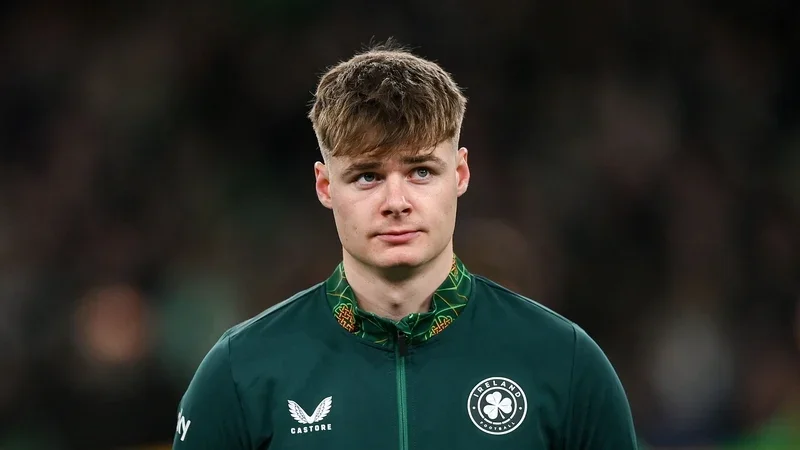
The Irish players who have reportedly told the team that they don’t want to play the game have received plaudits from Irish fans on social media. The only named player in a report from the Irish Independent, written by Daniel McDonnell, so far has been Gavin Bazunu.
Some notable names who have praised the young Bolton Wanderers goalkeeper include Bohemian associate Daniel Lambert and Kneecap, who have described Bazunu as a hero.
It would be easy to speculate and jump to conclusions at the moment; it will be vital to observe this developing situation.
Ireland’s national team reaches the eleventh hour as it faces one of the team’s most controversial ties in its history, where now the players could potentially be the deciding voice on what happens next
Golden Generation?
Credit: RTÉ
Maybe We Should Temper Expectations
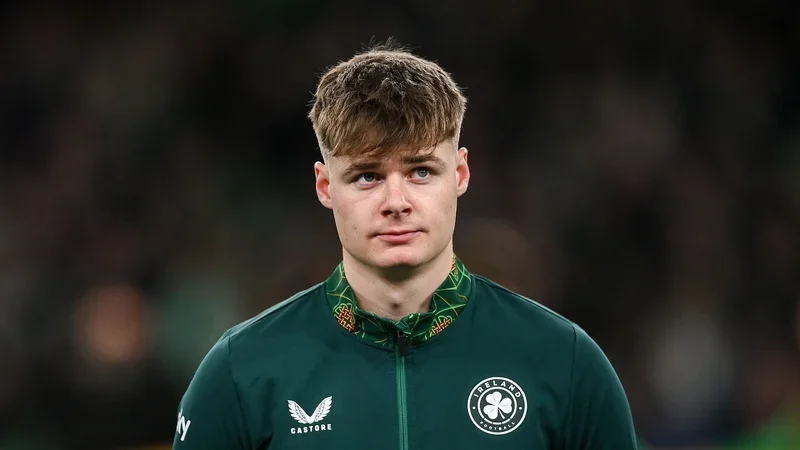
With a batch of exciting young talent going across the continent from the island, many fans are starting to become excited for the up-and-coming generation of footballers. Considering many players have been linked to some of the biggest sides in the UK, many might want to start heralding this as a “golden generation”. However, should we temper expectations slightly?
After the failure to reach the World Cup was confirmed by the heart-wrenching loss to Czechia, Ireland had already scheduled friendlies in hopes of warm-up matches before the North American World Cup was due to kick off in June.
Ties were confirmed against Grenada, Qatar, and Canada, with the team selections set to be interesting.
Would Heimir call up the U21 and lower best performers, or would he be set to continue to have his team gel, considering the team will now be set to look towards European qualification for an event on home soil?
The Next Generation
Thankfully, Heimir would inevitably decide to call up some prospects for the Irish National Team. Some including Umeh, Melia, Rory Finneran, among many others.
Covered at length, Umeh looks to be one of the strongest emerging prospects for the Irish National Team, where the wing depth has often looked thin, and Azaz, a natural 10, has had to cover when the set-up switched to a 5-2-3.
Umeh has impressed for the underage groups of Ireland and Benfica. Hopefully, the former Cork City player can become a regular fixture in the Portuguese League. His journey to this point can be read here!
Melia, now a Spurs player, may look to kickstart his Spurs career in the coming season off the back of a difficult season for the North London outfit, with relegation narrowly avoided on the final day.
Melia made his senior debut, where he played 20+ minutes as a substitute against World Cup hosts Canada. While not a massive amount of experience was gained, it will prove to serve the prospect well in gaining experience in the camp.
Much is to be seen with how Melia’s Spurs career could turn out, with obvious parallels to be drawn from the current talisman for Ireland, Troy Parrott’s career.
Rory Finneran, the youngest player to ever play for Blackburn Rovers at the age of 15. The young midfielder would soon take his talents to the Newcastle academy.
A player profile that the Boys in Green are becoming increasingly in desperate for where the midfield depth has looking troubling.
Finneran possesses an impressive ability to read opposition passing lanes and a progressive passing range, which might be the solution for the Boys in Green.
Finneran will need to solidify his professional career by going on loan or gaining minutes in the senior team before he can become a mainstay in the National Team.
Expectations
Discussing the players mentioned, one thing becomes clear: these players are human and that they are young. Before piling on expectations that they will lead us to the World Cup again, we must recall how expectations have led to disappointment before.
Evan Ferguson, who last year had a good yet frustrating season at Roma, where playing time proved to be more limited than expected, would have performances with increased confidence despite the criticism from Gasperini.
First thought of as a perfect fit, where the former Atalanta coach’s history of transforming strikers’ careers was noted. Soon became a thing of nightmares as Gasperini would begin to criticise the striker who was once linked with Manchester United.
Ferguson has long suffered extensive periods on the sideline, especially with his ankle, which might be a consistent problem for the still young striker.
With this all in mind, Evan Ferguson is still only twenty-one years old with his whole career ahead of him. Upon his breakout season under De Zerbi, many declared that we finally had an Irish Wonderkid.
Immediately given the number 9 for Ireland, and links to teams where Brighton declared he would not be sold for under £100 million.
All of this spotlight for a kid must be dizzying, where the expectations of a dormant football-mad country certainly pile up on this too.
I think it must be understood that anything could happen for these players, whether it’s injuries or just unfairly placed huge expectations.
While it is true that Ireland possesses a strong group of young talent, it can be easy to become excited about. Two things can be true at once.
Luck, injuries, and many other factors play into how these players’ careers can be shaped. So, rather than add further detriment and expectations, we should allow these players to play and hopefully, the holy grail of a World Cup campaign will come.
Jaden Umeh, Irish Starboy? His Short Career So Far
Credit : Irish Examiner
Amid a fruitful end to the qualifying campaign for the Irish National Team, there is much to be excited for the Boys in Green. Where Heimir seems to have finally found his footing. There is, similarly, a slew of youngsters who look like they can become legends among the pantheon of greats for Irish Football. None more exciting and noteworthy than Benfica’s Jaden Umeh. How has the youngster’s short career fared so far, and how does that play into the rising potential of the Irish squad?
Evident from a seven-game unbeaten run (in 90 minutes) and five clean sheets along the way, the Irish national team is finally on an upward trajectory. It seems like, following Troy Parrott’s heroics, faith has been restored among the country, and it is fair to say that manager Heimir Hallgrímsson has made himself a truly popular figure among the Irish faithful.
Luckily for Ireland, this upward trajectory extends far beyond the senior squad. Players from underage academies are exploring new options across Europe, generally completing a proper coming-of-age transition into senior football.
It is worth mentioning that while a surge in the quality of young talent has been evident since the start of the 2020s, a variety of outside factors previously kept that specific bracket of players from reaching their full potential. More simply, things are changing. The land of Shamrocks has finally found its four-leaf clover.
“Moving at 16 by myself was a bit of a change, leaving home to live alone in a new country with a new language, but I just had to let my football do the talking .” Those were the exact words of Jaden Umeh after he came off the bench to make his senior international debut vs Qatar.
With arguably most of the spectators heading to the AVIVA to watch his long-anticipated debut, it is fair to say that he didn’t disappoint. With his very first touch, Umeh effortlessly glided past two Qatari defenders, also winning a corner for Ireland. But while a boyhood dream under the Aviva floodlights finally came true, it was the culmination of a long and challenging journey.
Long before dominating in the sun-soaked pitches of Portugal, Umeh’s footballing story began at Ringmahon Rangers in Cork. Joining the club at just four years old, it didn't take long for local coaches to realise they had an exceptional talent on their hands.
By the time he was seven, Umeh was routinely playing two age groups up. A natural progression to Cork City FC followed, where Umeh's transition into senior League of Ireland football was seamless. His combination of raw power on the wing and intelligent movement really made him stand out.
As a result, Umeh has already started to attract interest from clubs abroad. However, since Brexit restrictions shifted the traditional pathway for young Irish starlets away from England, Europe's elite came knocking. In 2024, at just 16 years of age, Umeh made a career-defining decision to sign for Portuguese giants Benfica.
With Umeh doing exceptionally well for both Benfica's U23 and U19 sides, his reputation skyrocketed following standout performances for Ireland at the U17 World Cup in Qatar. By May 2026, Umeh had truly announced himself in the UEFA Youth League.
He put in standout performances against Slavia Prague and AZ Alkmaar. He bowed out of the European campaign with three goals and three assists in just ten appearances. As a result, legendary Real Madrid-bound manager Jose Mourinho called him up to train with the first team, and he received his first-ever call-up to the Ireland senior squad for a friendly against Grenada.
However, due to Benfica not having yet secured a spot in next year’s Youth League, he was forced to withdraw from the Ireland squad. Little did we know that was a blessing in disguise, as he went on to receive a call-up to the senior squad once again, with this time, however, being set to face Qatar and Canada, both of which are World Cup 2026 bound…
Our first goal of the U17 World Cup was scored by, funnily enough, Jaden Umeh. The player who set him up was Newcastle’s Rory Finneran.
Illustrating a truly up-and-coming generation of exciting Irish youngsters, where Umeh has already flourished at many age groups. Much can be imagined where the “wonderkid’s” career will take him, but one thing is for certain: many Irish football fans will be following his journey.
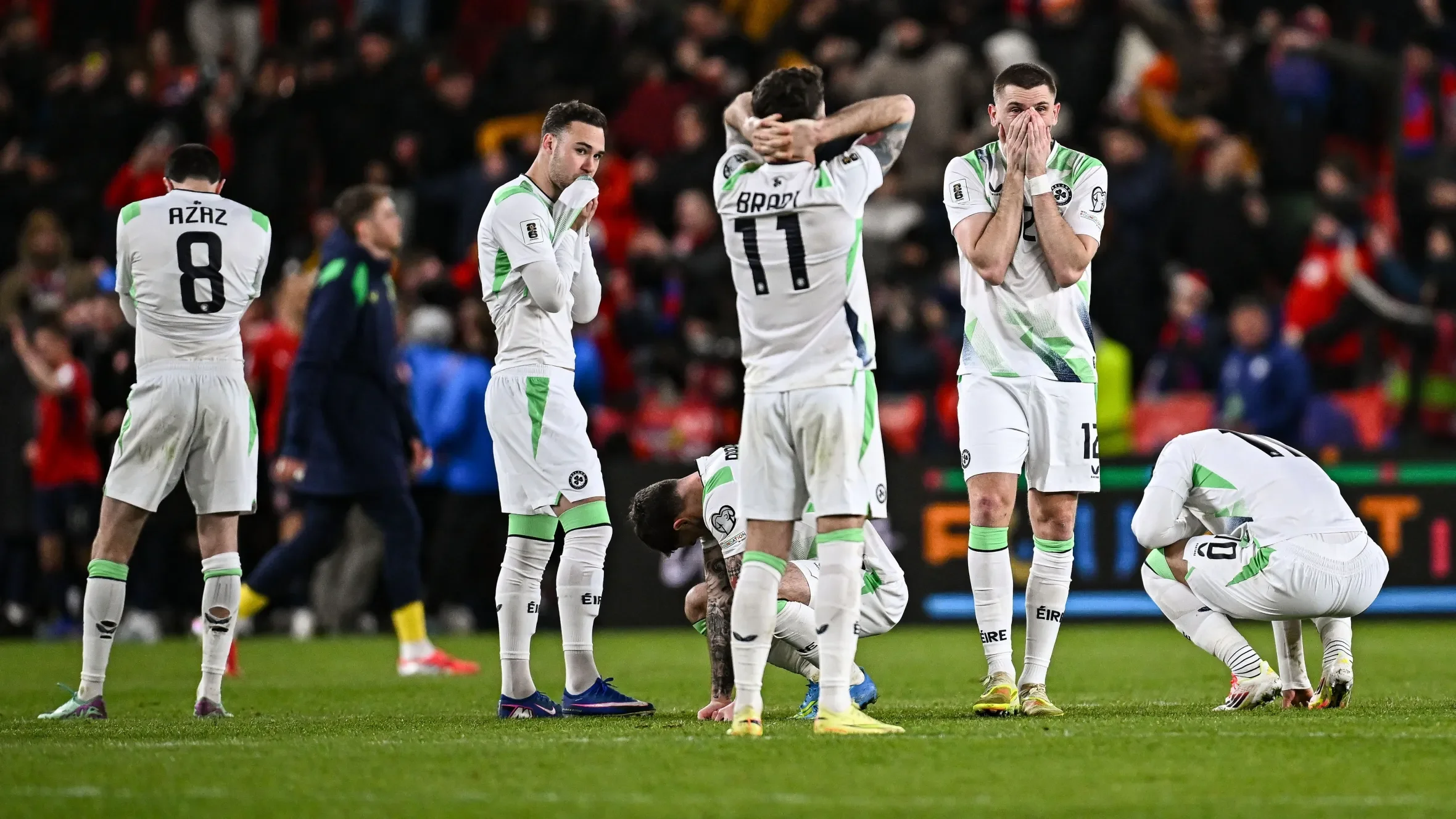
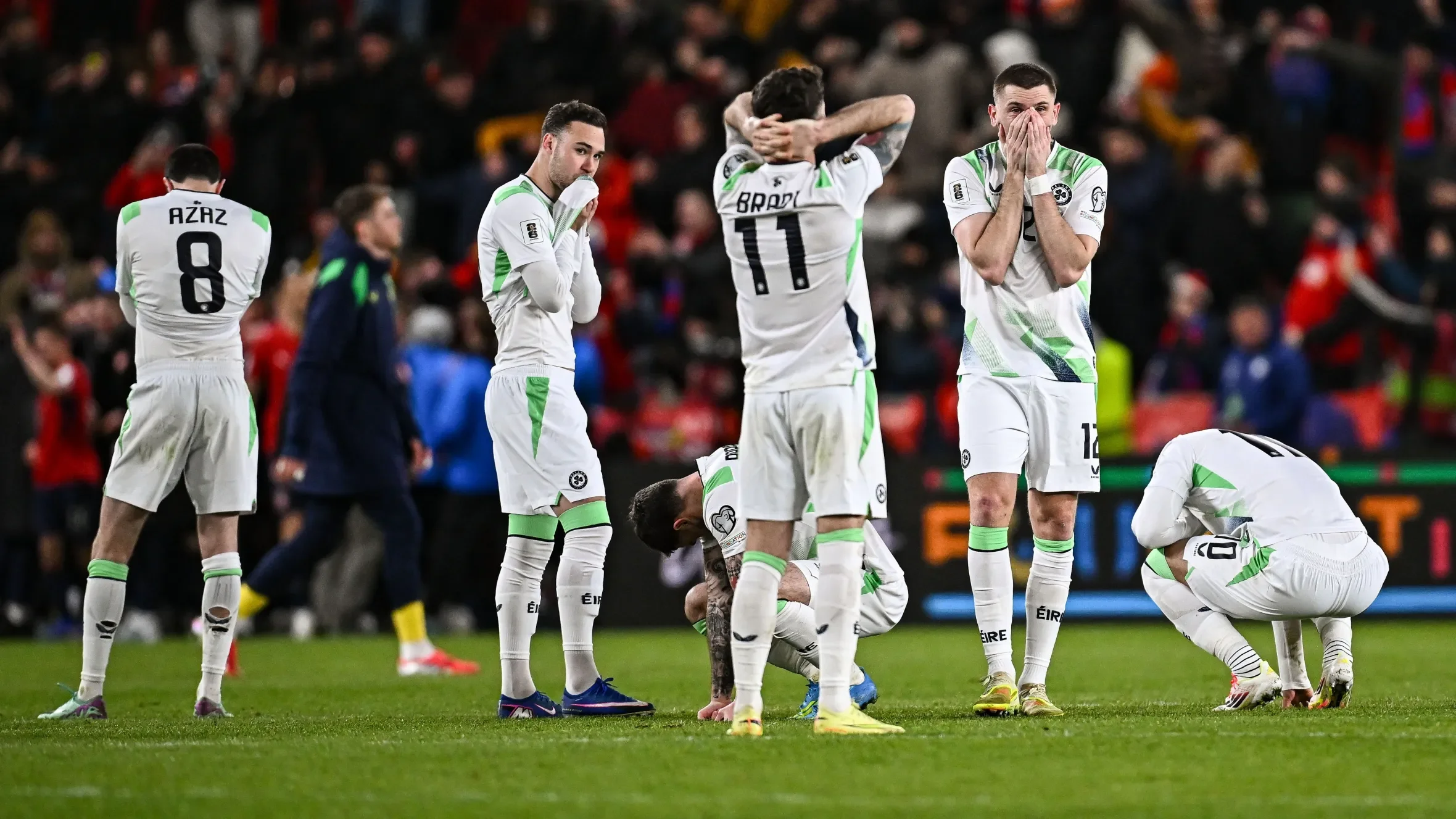
Why Ireland’s Prague Exit felt Nothing Like Denmark
Credit - The Irish Times
Coming into the big play-off home leg vs Denmark, the Irish starting XI was in solid club form across the English leagues, with several players establishing themselves as key figures for their teams and most of them being key starters for their respective clubs. All of the players in the squad plied their trade in the Premier League and the EFL Championship.
Starting in goal, Darren Randolph had become an instant fan-favourite at Championship side Middlesbrough. He had just joined them in the previous summer from West Ham, for whom he had been a consistent performer in the previous season despite often playing as the back-up keeper.
He had started 16 games and kept 7 clean sheets by mid-November. His club teammate Cyrus Christie played every single minute at right-back for Hull, while netting 1 goal against Fulham in September. Some Hull fans were, however, critical of the defensive aspect of his game.
The centre of defence featured Shane Duffy, who was quite literally in the form of his life for Brighton, statistically the most dominant aerial defender in the Premier League, appearing in all 11 of Brighton’s opening games.
His centre-back partner was Newcastle's Ciaran Clark, who had 1 goal in 10 starts during the Magpies' return to the English top-flight, while occasionally being a starter for them due to facing competition from Jamal Lascelles.
A core trio from high-flying Burnley, who went on to finish 7th in the league, was supposed to have provided much of the team's stability in that crucial final vs Denmark. Robbie Brady was the creative engine with 11 appearances and 2 assists.
Meanwhile, Jeff Hendrick was a key part in Sean Dyche’s Burnley side with 10 games and 1 goal (a crucial winner against Everton), and Stephen Ward, who enjoyed a career-best run at left-back, starting 11 games and scoring a stunning volley on the opening day against Chelsea.
Back at midfield, David Meyler had established himself as a leader for Hull City, captaining them several times and scoring 1 goal in 12 Championship appearances, while Harry Arter had made 9 Premier League starts.
Further forward, James McClean was a regular for West Brom with 11 appearances, often providing high-intensity energy from the bench, and finally, veteran striker Daryl Murphy touched down in Dublin in top form, having bagged 6 goals in 15 starts for Nottingham Forest.
The Look In (July-August-March 2026)
As the Boys in Green prepared for their historical trip to the Fortuna Arena in Prague, the squad arrived with significant momentum from a dramatic comeback against Hungary about four months ago. There was a mix of players who were regular starters and some who weren’t getting a lot of minutes (not necessarily due to low quality).
Starting off in goal, Caoimhin Kelleher had become an instant fan-favourite at Brentford; he had joined them from Liverpool to secure first-team football and arrived in Prague as one of Europe's top-performing keepers, boasting a 7.58 average rating (WhoScored).
His club teammate and captain, Nathan Collins, wasn’t having the best possible season at Brentford, facing a period on the sidelines before eventually working his way back into Keith Andrews’ Europe-chasing side.
The defence also featured Everton’s Jake O'Brien, who absolutely excelled in the few times that he actually played at centre-back due to being forced to play at right-back because of Everton’s lack of fit right-backs. Finally, Dara O'Shea had so far been a key player for Ipswich Town throughout their impressive top-flight return race.
Veteran leader Séamus Coleman was handed a start at right back despite not having played a single game in 2026. As per usual, he didn’t give that impression on the pitch and continued to show why he is probably the most respected player in the Premier League and amongst the Ireland setup.
At left back, Ryan Manning was enjoying a strong run for Southampton despite a relatively slow start, providing vital delivery from set-pieces, while Jack Taylor had only missed one league game for Ipswich Town from mid-October to right before the play-offs.
As for Chiedozie Ogbene, it was the complete opposite. While on loan at Sheffield United, Chris Wilder kept leaving him out of the reckoning, giving Chieo just over 40 league minutes between November’s and March’s international break and sending him to the U21s.
Also in midfield, Jayson Molumby had established himself as a leader and captain for West Brom, while Finn Azaz -despite some ups and downs- was a key creative spark for Southampton, having scored 9 times and assisting on five occasions leading up to the game.
Finally, regarding the striker position, not much needs to be said about Irish hero Troy Parrott, who was in blistering goalscoring form for AZ as well as leading Ireland's qualifying stats with 5 goals and in a way sending Ireland to the play-offs.
The humbling home defeat vs Denmark can be attributed to a good few factors, but they can be narrowed into two, really: the players ultimately not showing up and Martin O’Neill making some poor and impulsive substitutions at half-time. Despite the game starting in the best way possible for Ireland through a Shane Duffy goal set up by Robbie Brady, it all went black for Ireland then, with most of the players simply not replicating their club form.
Cyrus Christie scored an own goal, bringing the Danes back in the game and failing to contain Pione Sisto. Ciaran Clarke had a poor game and was taken off in the 71st minute for Shane Long in a desperate attempt for late goals, while Shane Duffy, despite his goal, was part of a defence that collapsed in the latter stages of the tie.
Stephan Ward had arguably the worst performance with an Ireland jersey, costing Ireland two goals. In midfield, captain David Meyler got hooked at half-time alongside Harry Arter, who played a part in Denmark’s equaliser. Jeff Hendrick struggled to create and faced a really difficult task in the second half. James McClean had a big chance to double Ireland’s advantage, while his fellow wing-back Robbie Brady provided the free-kick that led to Duffy's opening goal, but was dispossessed in the build-up to Eriksen's first strike. Lastly, Daryl Murphy was really isolated up front, barely receiving the ball to his feet. It was regarded that our best performer at night was actually Randolph, who, despite conceding five, saved the Danes from getting more.
On current Celtic manager Martin O’Neill, it all went out of control when, with Ireland trailing 2–1, he replaced the two holding midfielders (David Meyler and Harry Arter) with the attacking duo of Wes Hoolahan and Aiden McGeady.
That left a gap in Ireland’s midfield that allowed high-flying Christian Eriksen to have a field day in Dublin, effectively finishing the Boys in Green off. O’Neill also had a dispute with journalist Tony O'Donoghue, resulting in him storming out of the post-match interview.
Where did it go Wrong?
In a match where the host country -once again- held its breath, the starting XI in Prague put in a really good shift but ultimately couldn’t get a two-goal advantage over the line, eventually losing on penalties after extra time.
Firstly, Caoimhín Kelleher was solid whenever called upon. At the back, Nathan Collins was a rock, putting in a proper captain’s performance and winning aerial duels left, right and centre. He also had a superb effort come off the bar.
Jake O'Brien also did well, but gave away a few sloppy fouls showed great composure on the ball, but was caught slightly out of position for the late equaliser. Dara O’Shea had his best-ever performance in an Ireland shirt, playing a massive part in Ireland’s second goal. On a defensive basis, he consistently made important tackles, cleared the ball on multiple occasions and carried the ball forward in a very capable manner
On the flanks, Séamus Coleman rolled back the years with another superb defensive display. As per usual, he gave it all for his country in what, unfortunately, might have been his last ever competitive Ireland game.
Ryan Manning, on the other hand, had a night to forget, with the critical error of giving away a completely needless penalty that brought the hosts back into the game. In the engine room, Jayson Molumby was superb in all aspects as he hit the bar once, while Jack Taylor linked the play well in the first half but faded as the Czech midfield began to dominate possession following Thomas Soucek’s introduction in the second half.
Finn Azaz didn’t get involved enough as his night ended in devastation with a saved penalty in the shootout, and his utilisation on the left side of the pitch remains questionable, as he continuously goes missing.
Chiedozie Ogbene was Ireland's primary outlet, using his pace to win several free-kicks and also carry the ball forward. Up top, Troy Parrott was ice-cold from the penalty spot to give Ireland the lead and worked tirelessly as a lone striker, but he was ultimately left isolated as Czechia grew into the game.
However, despite both of the games sealing Ireland’s fate in the worst way possible, there is one basic contrasting sentiment among Irish fans. In a way, the Prague performance represented a "new dawn," whereas the Denmark loss felt like a "dead end." While both games ended in heartbreak, the 2026 exit is viewed through a lens of optimism.
On a personal note, I buy into that argument. Just take a look at the average squad age of the side that took on Denmark and the side that took on Czechia. Up against Denmark - 29.4 years, versus Czechia 24.8. You just get the feeling that our current crop of players is entering its prime.
Also, the nature of the performances differed big time. While the game vs Denmark was a home embarrassment, Ireland went away to Prague and scored twice inside the opening twenty-five minutes and even hit the crossbar twice. Czechia grew into the game because of a sloppy penalty, so this game could be considered a footballing accident.
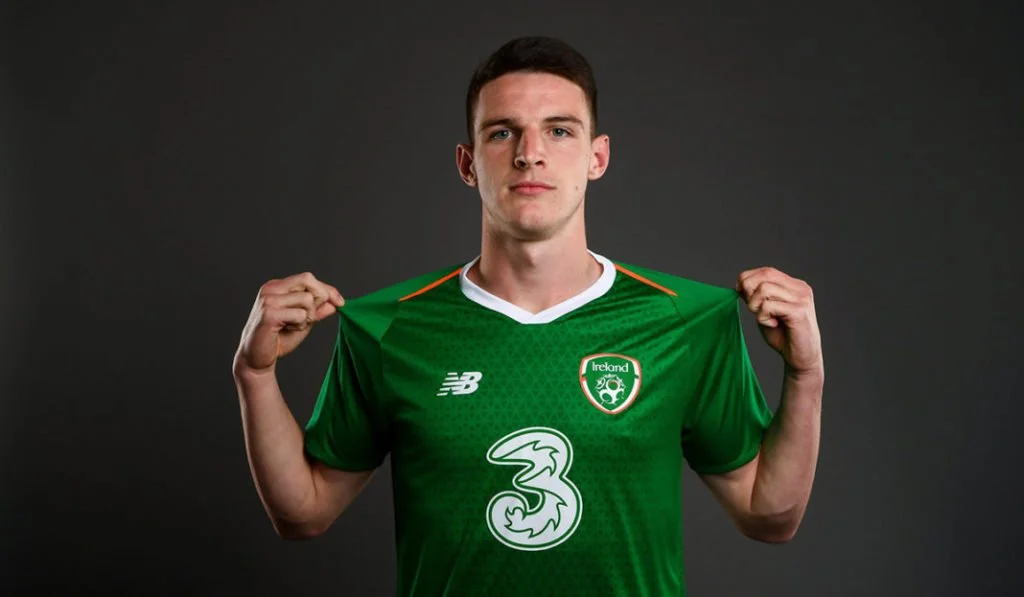
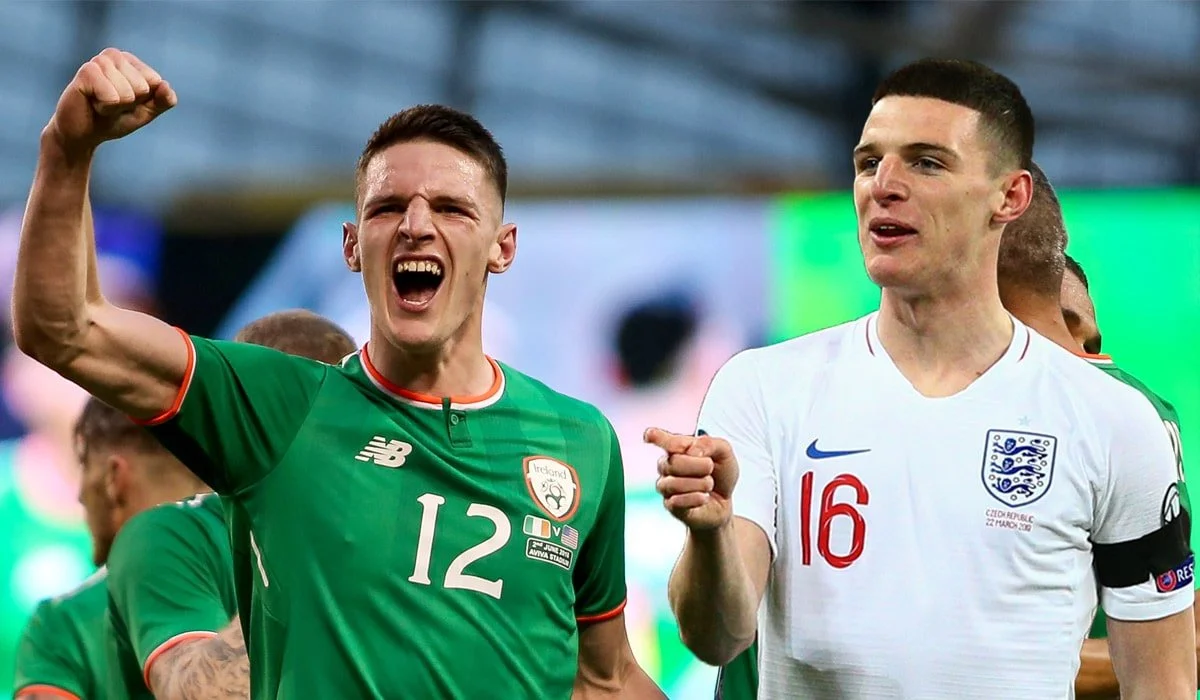
Is he Irish enough? The Great Divide over “The Granny Rule”
Credit - Extra.ie
While the Irish outfit stood together in Prague, they would undergo 120-plus minutes leading to heartbreak. Irish people sat watching in anticipation, but were met with a familiar and increasingly topical sight.
As Amhran na bhFiann rang out, some players were noticeably unfamiliar with the anthem. Jack Charlton utilised the “Granny Rule” and brought together perhaps the most beloved Irish team of all time, yet now we meet the same arguments.
As a commitment is announced, one side meets it with a groan, and some meet it with excitement. But how does the Irish public decide who is an Irishman?
What is “The Granny Rule?”
Colloquially referred to as the Granny rule in Ireland, the ability for first and second-generation emigrants with Irish descent to declare and make themselves eligible for Ireland. Considering the vast amount of Irish Diaspora across the globe, with the Irish culture of emigration. This would give Ireland a significant boost in eligible players
The Jack Charlton Revolution
Upon appointment to assume the helm of a nation that had never qualified for a major tournament, Jack Charlton quickly assessed the squad and arrived at a conclusion. He was set to specifically target and harness the granny rule.
Charlton, in 1986, scouted the UK aggressively for Irish-eligible players. Soon, he would convince some players to commit who would go on to become legends in Irish football.
Among the pantheon of greats for Ireland are John Aldridge, Ray Houghton and Andy Townsend, among many others. Houghton, especially, is still remembered for his iconic goal against England in the Euros, whilst still providing match commentary for RTÉ, including his iconic animalistic scream when Parrott sent Ireland to the playoffs.
Here comes the contradiction, however, as the nostalgia of Italia 90’ alongside the sixth place ranking in the FIFA national team table, many do not mention the presence of players who had to be reached out to for commitment. Does this dictate that the response for the Granny Rule only matters when we do well?
Heartbreak stemmed from prospects
After a fairy tale in Euro 2016 in France, Ireland would begin to sharply decline as the lack of funding in infrastructure would begin to finally catch up. The O’Neill – Kenny era would feature some notable examples of failed Granny Rule players.
Notably, Declan Rice and Jack Grealish would famously trade the Green for the White. Both still remembered to this day where a Nations League match demonstrated the Irish’s ability to hold a grudge when the pair were met with boos and jeers.
It was perhaps these two instances where extremely promising players treated Ireland like a development team or a back-up plan. The heartbreak from the pair leaving alongside the realisation that they had “taken” caps from other Irish men has led to the growing scepticism and discussion on the topic.
Furthermore, despite Rice posting Instagram comments that included “Tiocfaidh or la”, he still left the setup. This inherently makes it necessary to consider what connections these players have to Ireland beyond familial ties.
Overall, this is where it can be understandable for Irish fans to have become jaded about the Granny Rule. It should not be unreasonable to call for more Irish players born in the likes of Mayo to Mountjoy.
However…
With a continued issue of football in Ireland, as it is set to compete with GAA, Rugby and many other sports. Coupled with the issue of the mismanagement of funds from FAI under Delaney in the 90’s and 2000’s, Ireland in the meantime, needs the diaspora.
Drawing these players in to play for Ireland to effectively bridge the gap between mostly reliance on Granny Rule to a healthy balance would be necessary. As we see more exciting youngsters who are proud to be Irish, such as the newly called-up Jaden Umeh, Ireland still has a huge gap in age between established players and the new generation.
I would argue on this basis, firstly, that we must utilise and harness this rule. Plugging gaps in the squad while allowing the new generation to learn under the tutelage of the players who may have come from better academies could provide immense experience.
However, another aspect becomes important to note. Does the inclusion of Irish emigrants reflect on the culture and identity of Ireland as a whole?
With a current 400,000 – 500,000 Irish emigrants living in the UK, and many more across the globe. Ireland is known for emigration from the days of the Great Hunger to the post-independence era.
But what is “Irishness”
The likes of Kevin Kilbane or Shane McGowan were men whom most Irish people wouldn’t think twice of as someone who is not culturally Irish. Which, overall, heralds the question of what determines Irishness?
Is it the connection to the culture, or is it as simple as an accent? Or realistically, is it just the case that it does not matter if we do well and qualify for a World Cup?
Depicting someone as Irish should really depend and only matter if they decide to put on the Green Shirt; it should not matter if they have a cockney, New York or Canadian accent.
Conclusively, the nature in which people claim to be Irish will always be responded to with our insular nature. One thing is for certain, however, with the culture of migration, colonial memory and division, Ireland has never and probably will never be able to a simple definition of “Irishness”
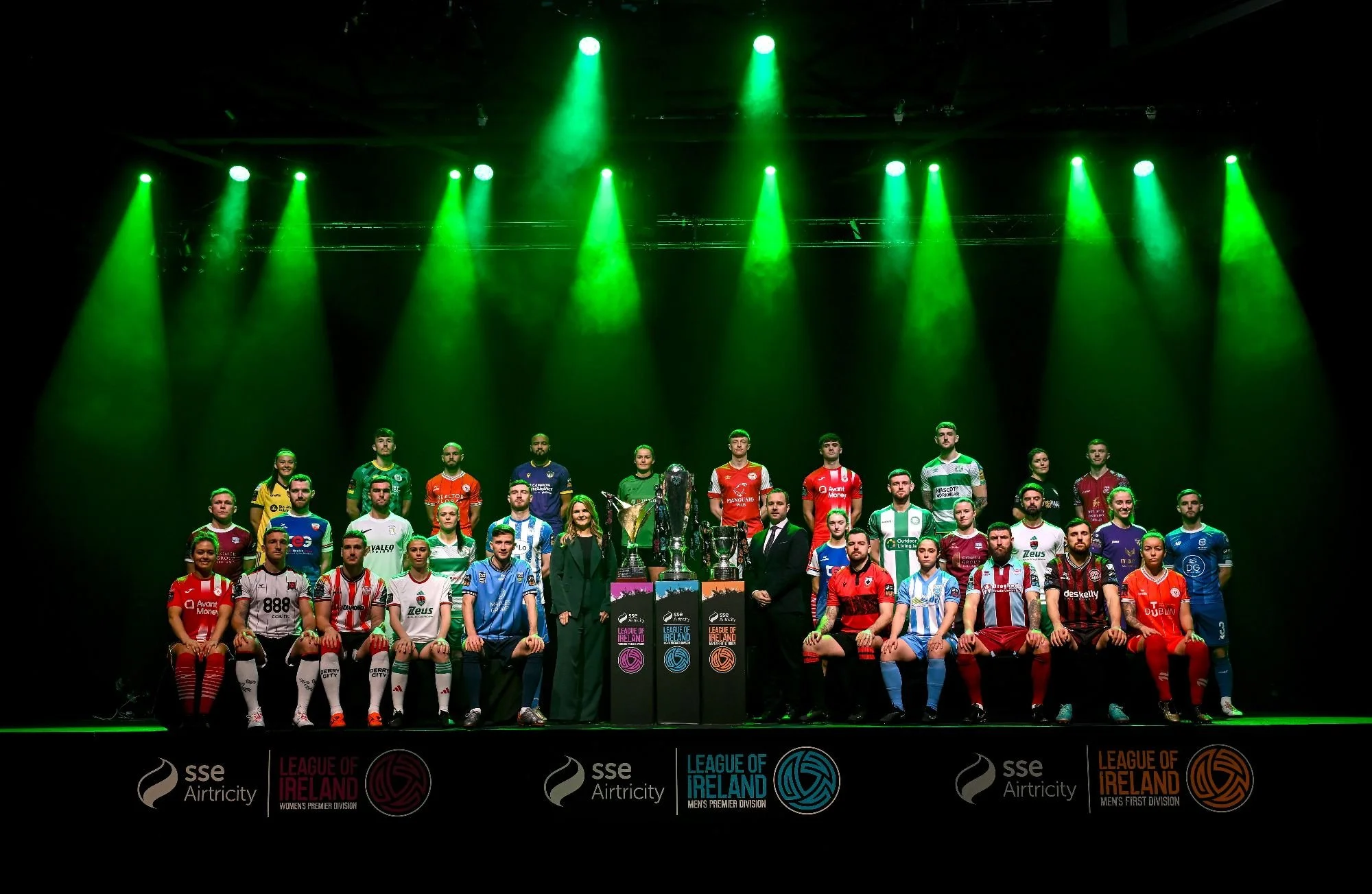
The League of Ireland: Irish Football fans finally look home
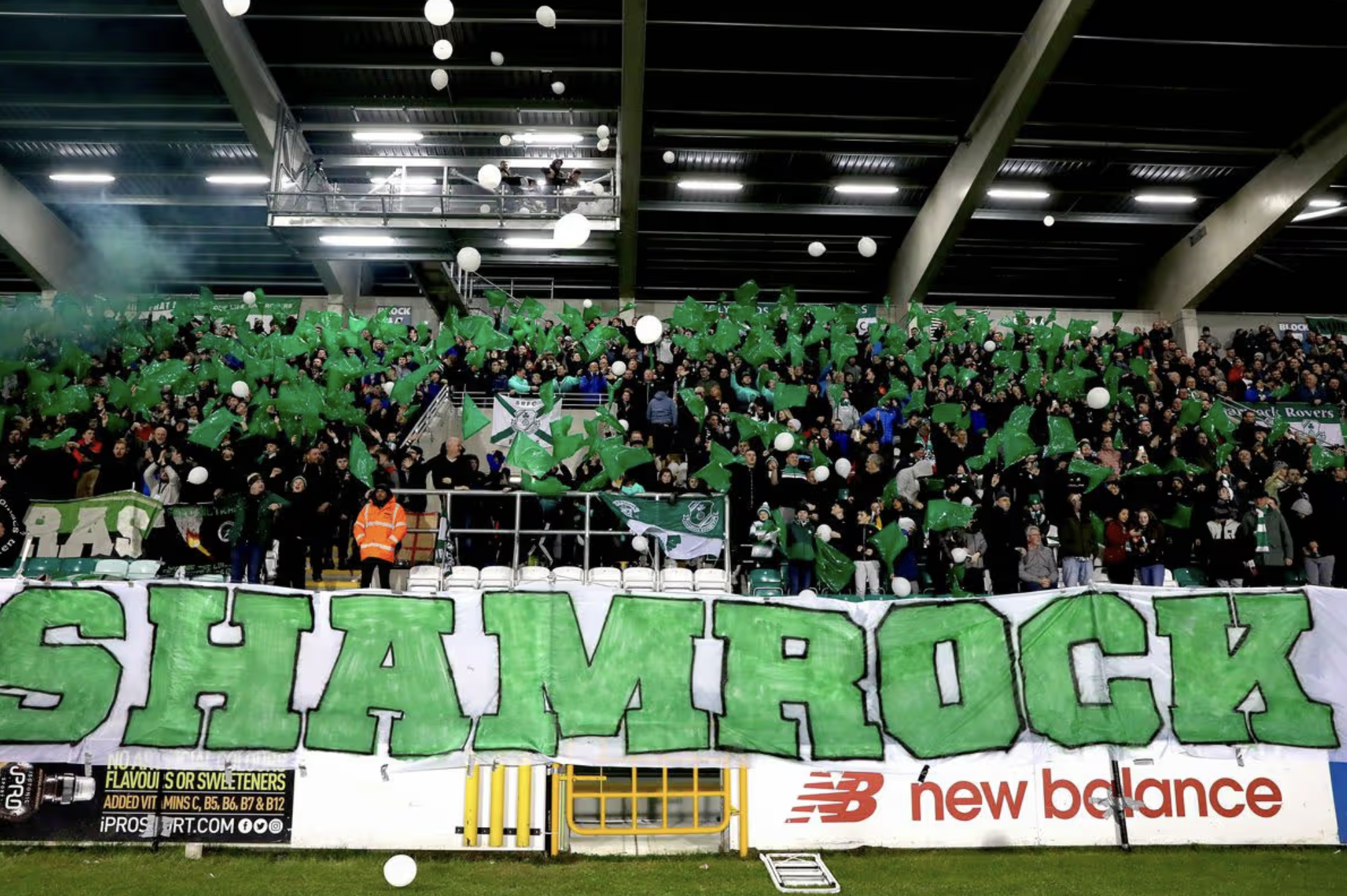
Credit - Irish Mirror
Ireland has seen a cultural revolution regarding music, language, and identity. A quieter transformation has taken place in the background. Once forgotten, now the League of Ireland experiences packed crowds, filled with young fans, fan culture, flags, and flares.
The once-forgotten league, where Irish fans across the country would sooner go into their local sports shop to purchase the red of Liverpool or Manchester United, has since begun to boom financially.
The League of Ireland has recently seen renewed and sustained interest. With record-breaking attendances at the landmark opening match of last season between Bohs and Shamrock Rovers.
Alongside, the improved performances of Irish teams in Europe have led to consistent qualification for the Conference League.
The League's financial improvements have coincided with increases in television viewership and attendance.
With this rise in mind, what are some of the root causes of the growth of the League of Ireland, and can it maintain its rise?
Fatigue of “the World’s Greatest League”
The Premier League is home to many clubs that Irish people have taken to over the years. For many Irish people, the Big Six see huge droves of fans and fan clubs alike across the Emerald Isle.
With the corporate nature of football, prices have grown exponentially. Not only have ticket prices risen for Irish hopefuls to partake in football tourism, but prices have also risen with subscription and TV prices.
Tickets have grown to unaffordable levels even for locals in the UK. For example, there has been an outcry over clubs outpricing their faithful fans over the last couple of years.
Key reminders of the visual protests from West Ham or Spurs with the black balloon protests immediately spring to mind.
Where the fans took to throwing black balloons on the pitch to protest the club’s attempt to remove concession prices for tickets.
While TV subscriptions have risen due to the number of games televised increasing. The average viewer would have to have Sky Sports, Prime and BT Sport to watch every possible game available on television.
Evaluating this and the current quality of the League, where the game has become hyper-fixated on set-pieces and controversy surrounding officiating and VAR has also contributed to the shift in interest in the country.
Culture and Community
Increased coverage of the League has demonstrated the fan culture that is available to prospective fans.
More televised games have illustrated the colourful flares, ultra-culture and fashion that the league has had to offer and thus, enticed viewers to experience match days.
Likewise, in the eyes of the general public, nothing is preferable to wearing a trendy jersey to a festival.
Excessive amounts of Bohemian jerseys have been worn and have even graced international celebrities such as Greta Thunberg.
Factors like these have aided the growth of the League, where the community aspect once experienced is helping to enable Irish fans to put away their English football kit and pick up a kit of a team from Letterkenny or Phibsborough.
Moreover, a huge criticism of fans not supporting their local situates itself in the community aspect.
Local fans are the first to scream and deplore “glory hunters”, where they ensure people that they cannot possibly enjoy football as much as they do due to not being in the locality and community.
While perhaps a bit exaggerated, it may have some truth. The average Irish fan is far more likely to find themselves relating to the history of a team close to them, while being able to work attending games into their schedule as a ritual.
This could depict why Irish fans are more likely than ever to proclaim their Irish team, where community is huge.
Think of the likes of the GAA, where I, a Laois man, wouldn’t dare claim to be a Dub in hopes of seeing an All-Ireland in my lifetime.
This logic, while slightly altered through the lens of football, could increase the interest in the League if more people were to adopt it.
Success at the European Level
As the clubs improve their performances in the European continental tournaments, this will only serve to enhance the chances of making new fans.
Fans are generally more likely to attend games if there is a chance to see a global football name on the pitch. Consider the Shelbourne and Crystal Palace.
The average Irishman was rarely able to get the chance to see a Premier League outfit with highly touted players compete in Drumcondra.
Now the average fan can get that chance. They get the chance to see Irish Teams compete at one of the premier competitions, which will only happen to boost interest in the League while increasing revenue if success continues at the rate over the last two years.
Can it be sustained?
The rise in interest in the league has resulted in a lucrative TV deal with Virgin and its own subscription model in LOI TV. However, it might not be time to call complete and total victory for the success of the League.
The infrastructure in the league remains extremely poor in comparison to countries of similar financial stature to Ireland. This can be noted with the poor quality of stadiums, too. Where this can likely result in teams looking to update their stadiums to align the quality of the stadium to modern standard risk the chance of eliminating what makes the league unique.
Finally, being beside the UK poses a threat, considering the poor wages on offer in the Republic, in contrast to the financial juggernauts of the Premier League. Young Irish talent bred in the Irish system has started to emerge as a growing trend.
Mason Melia, Jake O’Brien and Evan Ferguson are just a few names who, at a young age, decided to trade the League of Ireland for the world-class facilities and training of England. There is a further incentive for UK teams to deploy scouts to Ireland, where players are not required to get a work permit and can be counted as homegrown if they are at the club for three seasons and signed before 21.
These are some of the threats that the league faces. However, one thing is certain. Where once the stands of the League of Ireland saw empty seats and English jerseys, it now sees passionate fans and a growing culture in the heart of Ireland.
Ireland’s Identity Crisis: Ireland v Israel
Credit - Reuters
More Than a Sport
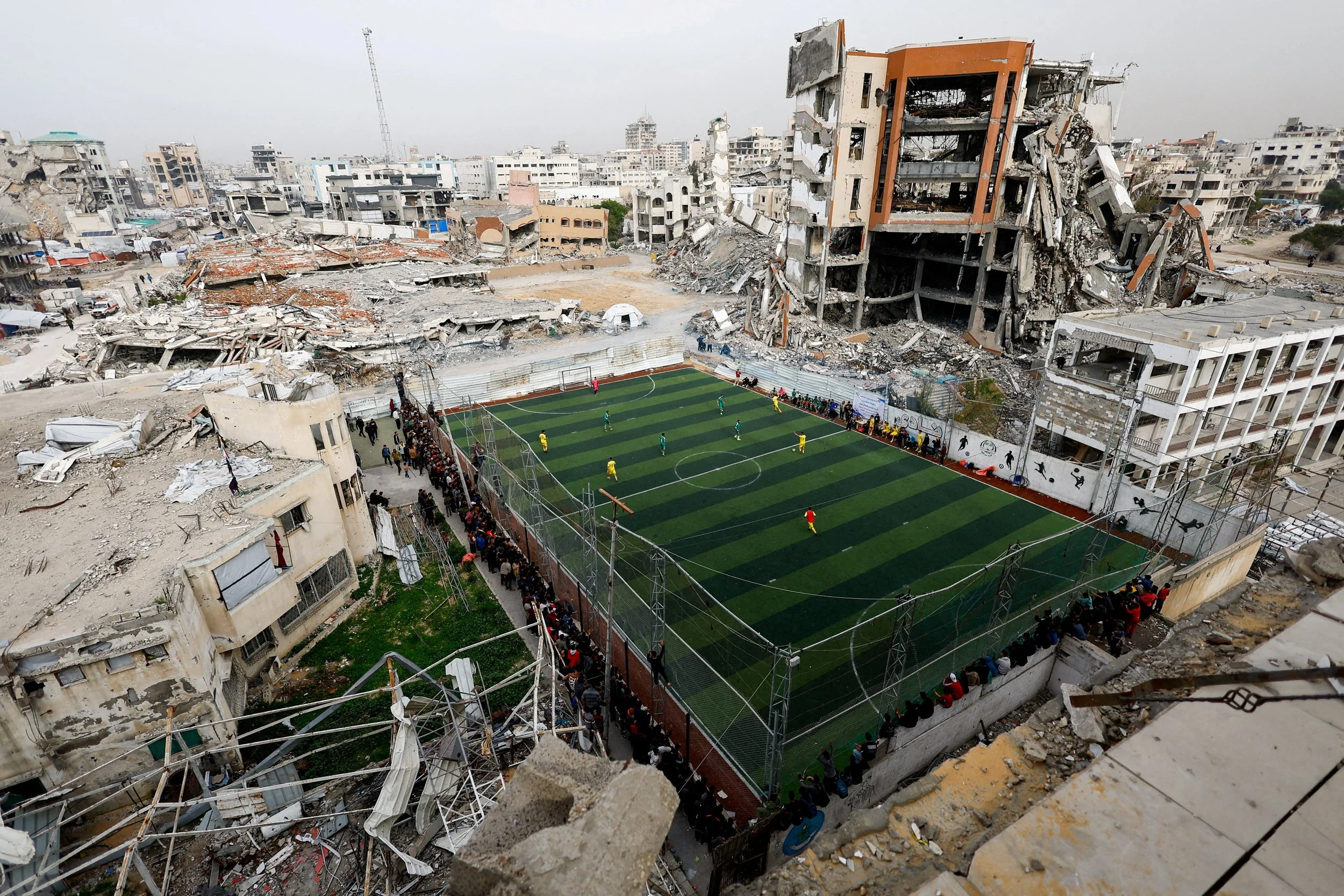
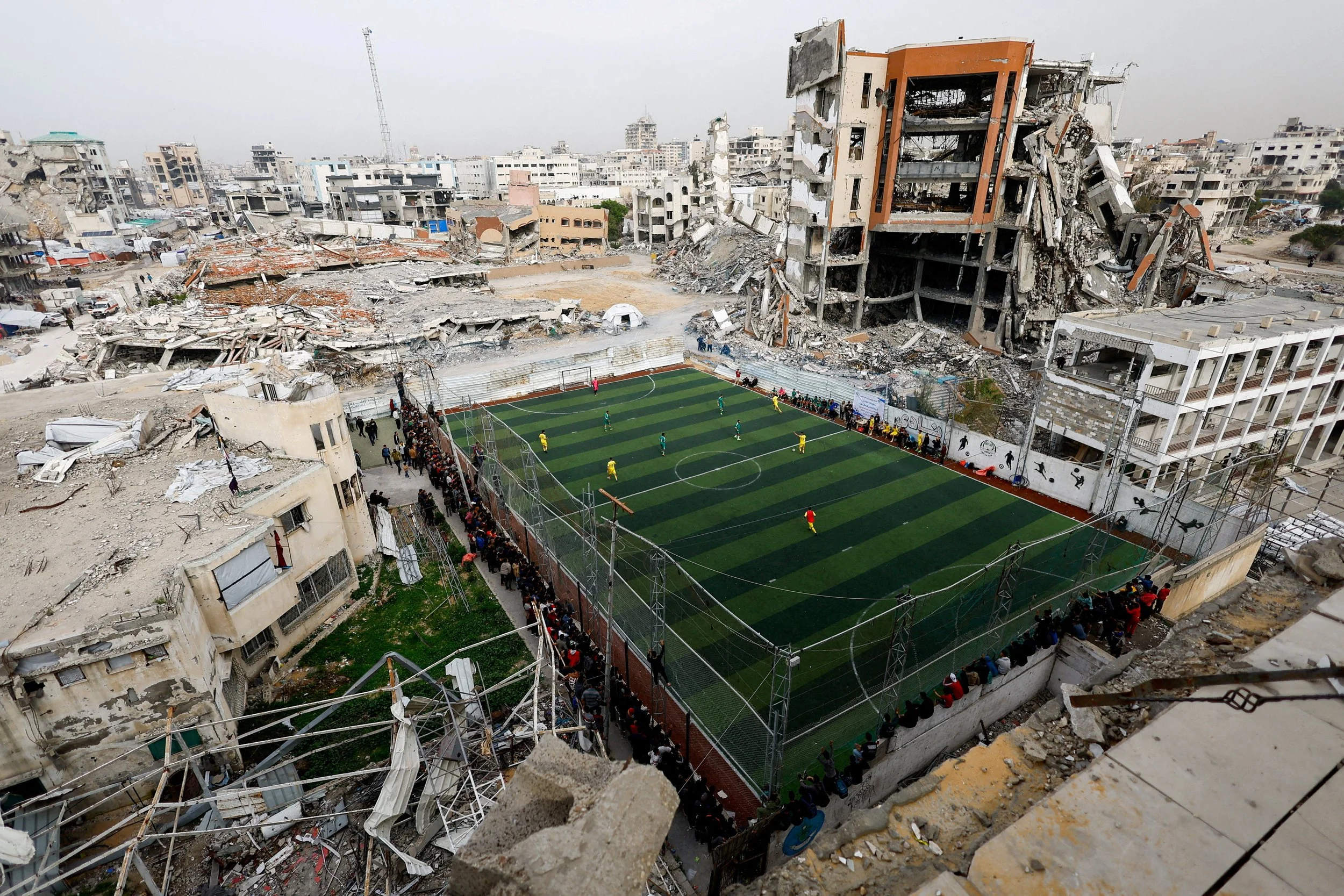
As the cries rang out, Ireland agonisingly failed to qualify for a Major Tournament for the fourth tournament in a row. An existential match began to come to the forefront for Ireland. Drawn against Israel, Ireland’s past of colonial struggle, independence, and parallels with Palestine were about to come head-to-head with the sporting realm.
On the Twelfth of February, Ireland was drawn into a Nations League group to play against Kosovo, Austria and crucially, Israel. Much had been made of the tumultuous relationship between Israel and Ireland. Immediately after the draw had concluded, the reaction was already fiery in response. Initial and quick calls for the National Team to decline to play the match commenced.
Consistently, whenever issues like this arise in football (or any sport for that matter), many clamour to “keep politics out of football”. In reality, this is much harder to do. Thus, it is undestandable to pose if it is possible to keep politics out of football
Whereas Israel has continued to play while it continues its ethnic cleansing of Gaza, other countries, such as Russia, have been banned from playing in continental tournaments, and similarly, their domestic teams have received the same treatment.
This is appropriate because consider if Russia and Ukraine played each other in a match. This can only display that it is not simply that, a match. It can become a cultural moment, or it can result in huge clashes.
While not on the same level as a Russia v Ukraine match or a match between Israel and Palestine themselves. The situation surrounding the Ireland and Israel game is massively important to understand.
Ireland and Israel Relations
Set in stone with the Balfour declaration in the UK in 1917, the Zionist project was set to go to Palestine and establish itself with the help of the UK. This is where the UK would redeploy the Black and Tans to “Mandatory Palestine”
This is just one of the obvious links as to why Ireland feels so strongly about the conflict as a whole. Further observations can be illustrated with the feeling of a cultural erasure of a homeland.
Ireland has similarly been one of the leaders in the Western world for the recognition of Palestine alongside Spain and Norway under the initial 1967 borders set before the ethnic cleansing of Palestinian land.
The Players and Match Base
Whether this match should go ahead beyond the historical significance of it should also consider the players, the fan base, and the general pr nightmare this match could potentially bring.
This match could certainly bring massive amounts of media spotlight with the scale of the tie, not on a competitive basis, but on a cultural one. The atmosphere at the Aviva will be tense should the fixture go ahead. This could lead to heightened clashes between the fans or the players on the pitch.
The players have been forced into an unwinnable fixture where the morality of the occasion will continuously be questioned, and the attendance could be stunningly low. Furthermore, there could be a flag policy put into action if Ireland were to get a considerable fine with Palestine flags flown from corner to corner.
Finally, if the match is to be played with huge boos to the Israeli anthem, the Israeli players and if a scuffle were to ensue on the pitch. Ireland has already unfairly gained the moniker as the “most antisemitic country in Europe” by Israeli officials, despite being one of the few to not have a state-sponsored persecution of Jewish people.
This match could provide evidence and depict Ireland in a bad light if it were to go ahead. Similarly, a player who potentially could play his first cap or his last cap could have his career marred with accusations of antisemitism. Realistically, the match in itself presents Ireland in a highly volatile situation where the actions on the pitch will not be the key discussion points.
Reactions
Considering the prospective animosity with the ongoing protests in Ireland and abroad, there has been an outcry among former professionals, too.
On the 7th of May, leading Irish footballers have sent an open letter labelled Stop the Game. Irish football personalities such as Brian Kerr and Irish women’s player Louise Quinn and Irish artists such as Kneecap and Fontaines D.C have taken to protest the match.
With pressure building, the FAI will have to determine whether playing the game will be worth it with all the noise surrounding the two ninety-minute affairs.
With 180 minutes of football to commence, a summer of noise and speculation will surround the game and the FAI will have to conclusively decide on the path it will take for the National Team. Will the game be played, or will it be the first step towards evaluating Israel’s place in UEFA.
The Irish Manager Revolution – Andrews, Barry and Hourihane.
Credit - The Southern Star
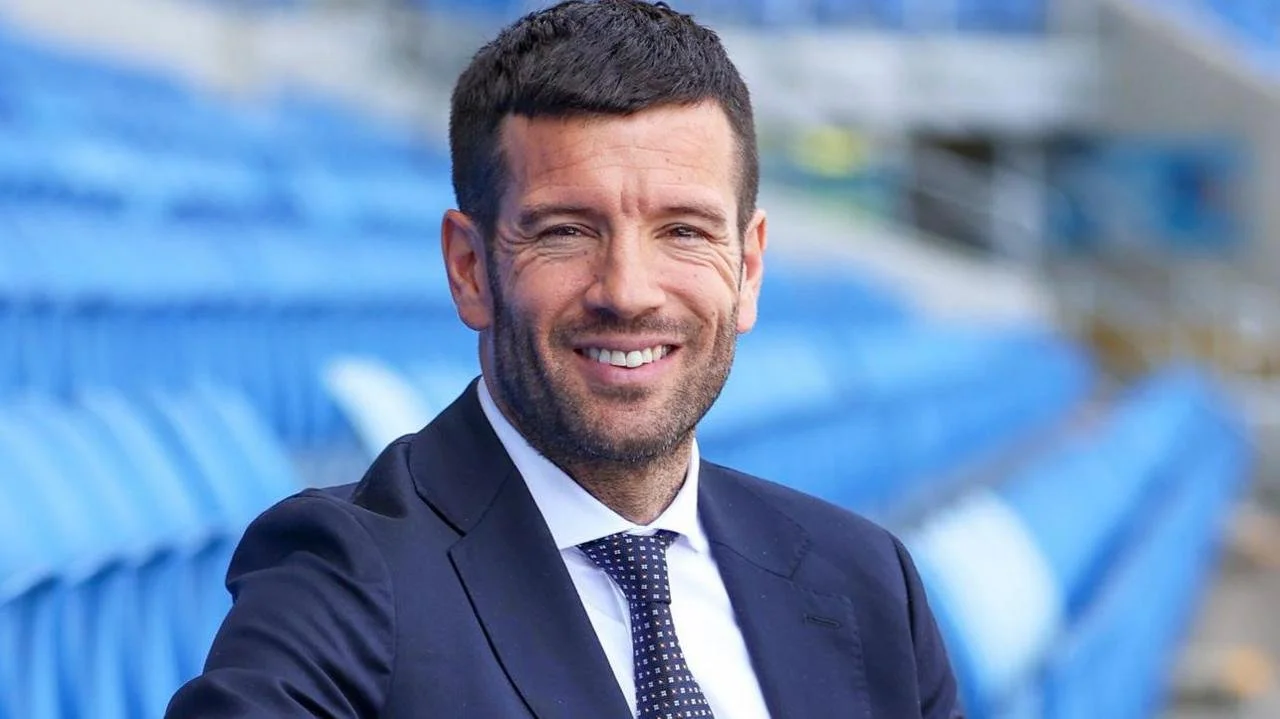
After years of not having established Irish coaches in the top three divisions of English Football, Irish coaches have seen several coaches who look to confirm their status in the managerial game.
The Old Way
The identity of Irish coaches has shifted. Where once celebrated managers, namely McCarthy and O’Neill, were at the pinnacle of Irish coaching.
The identity of Irish managers has changed. O’Neill and McCarthy were man-managers who were intent on a highly pragmatic system.
Now, Irish managers are being depicted as forward-thinking, indicating a shift in how the great Irish thinkers in football have adapted.
Killer Keith
Furthering his good start, which followed a summer of sustained scrutiny, Andrews has seen his side push to qualify for Europe this year.
Andrews has transformed his side into one of the deadliest counter-attacking sides in a season where that has grown in popularity.
Andrews has proved a lot of detractors wrong so far, as many Premier League fans bet on them to go down or for him to be firmly in the sack race.
Andrews has seemingly displayed impressive versatility and knowledge in the game, alongside striking man-management skills.
Andrews will hope to build upon a stellar first season. More can be read on Andrews’ first season here.
Hourihane and Murphy’s campaigns
While much of the focus has been directed at Keith Andrews, a quiet breath of success has occurred in League One this season.
Where Hourihane and Murphy have displayed a great ability in the managerial game for a long time to come.
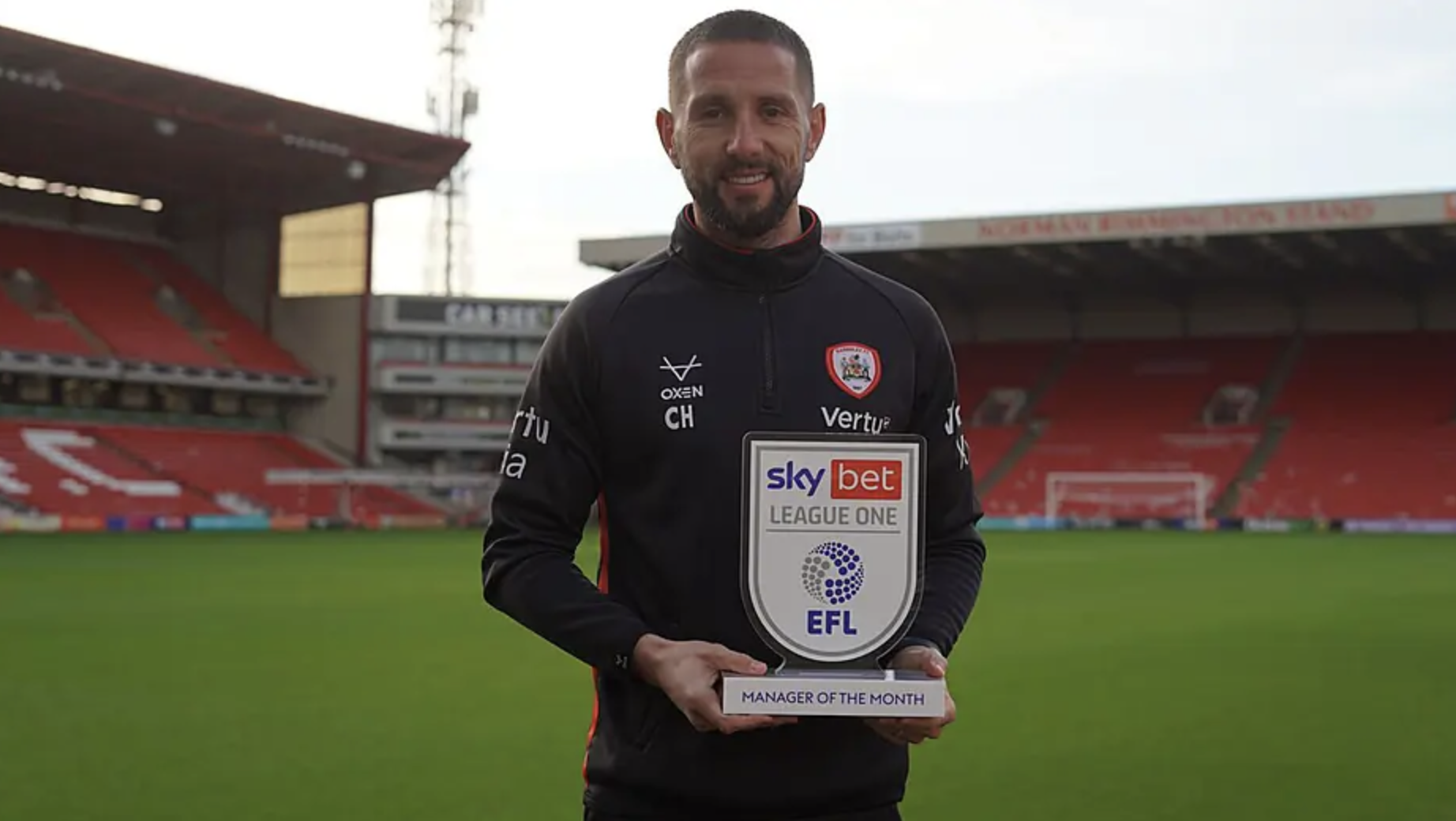
Hourihane has been the manager of Barnsley, who have challenged for the playoff positions up until a poor string of results in December, where their form has since dipped immensely as the Yorkshire club sees itself closer to relegation.
Many fans note his importance to the team and blame the poor form on the recruitment structure at the club.
Hourihane has displayed a clear identity in his tactical structure at Barnsley.
He took the ditch, the previously favoured 5-at-the-back at Barnsley. Favouring a traditional four at the back, with fullbacks in a 4-2-3-1.
The 4-2-3-1 in question sees the Barnsley team press high, which matches the zeitgeist of modern football.
Not intent on pigeon-holing himself into a style of play, he has similarly assessed the quality of teams he’s facing and adapted the team to deploy possession-based or counter-attacking football depending on what is needed.
Despite the praise for Conor Hourihane among the fanbase, he has decided to step down at the end of the season.
Where fans have responded, saying they would rather sack the board as a response to the mishandling of recruitment than to Hourihane’s announcement of leave.
It will be interesting to see what steps Hourihane takes in his coaching journey.
Meanwhile, Brian Barry-Murphy has led Cardiff to promotion and an impressive 91 points in League One.
Barry-Murphy found his name in coaching as a development coach at Manchester City and has finally followed this up by being named a first-team coach at the start of the 25/26 campaign.
Murphy’s experience in a club that employs Guardiola is very evident. His teams are noted for their high-pressing off ball.
Likewise, they draw parallels with Man City’s style of play, with high amounts of possession and a preference for control, opposed to chaos.
More similarities can be drawn; the fluid positional play and build-up phase are very reminiscent of the best aspects of Man City’s playstyle.
In possession, Barry-Murphy plays a forward-thinking 4-4-2 and has a similar shape in defence with an increasingly popular mid-block 4-4-2.
Barry-Murphy will be able to show his tactical nous in the Championship, where his style will be tested in the hardest league in the world.
With these three having success so far in England, hopefully, it can inspire like-minded Irish minds to thrust themselves into the Irish game and continue to evolve the imagery of what it means to be an Irish manager.
These managers display the developing trend in how the game is seen among Irish minds.
Where once they displayed pragmatism and dinosaur tactics, now Irish managers can see themselves as forward-thinking and progressive while harnessing the ideas of their predecessors
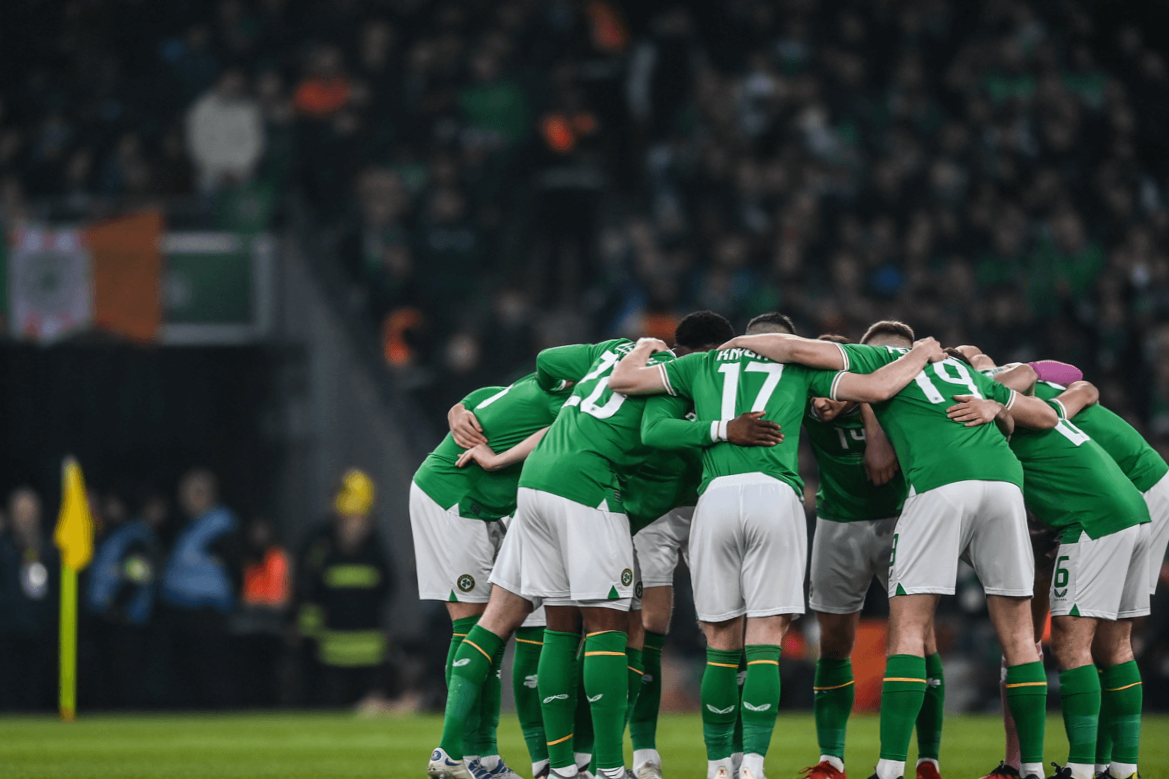
The Irish Team Review 2026: The Boys in Green Relight the Hopes of a nation again
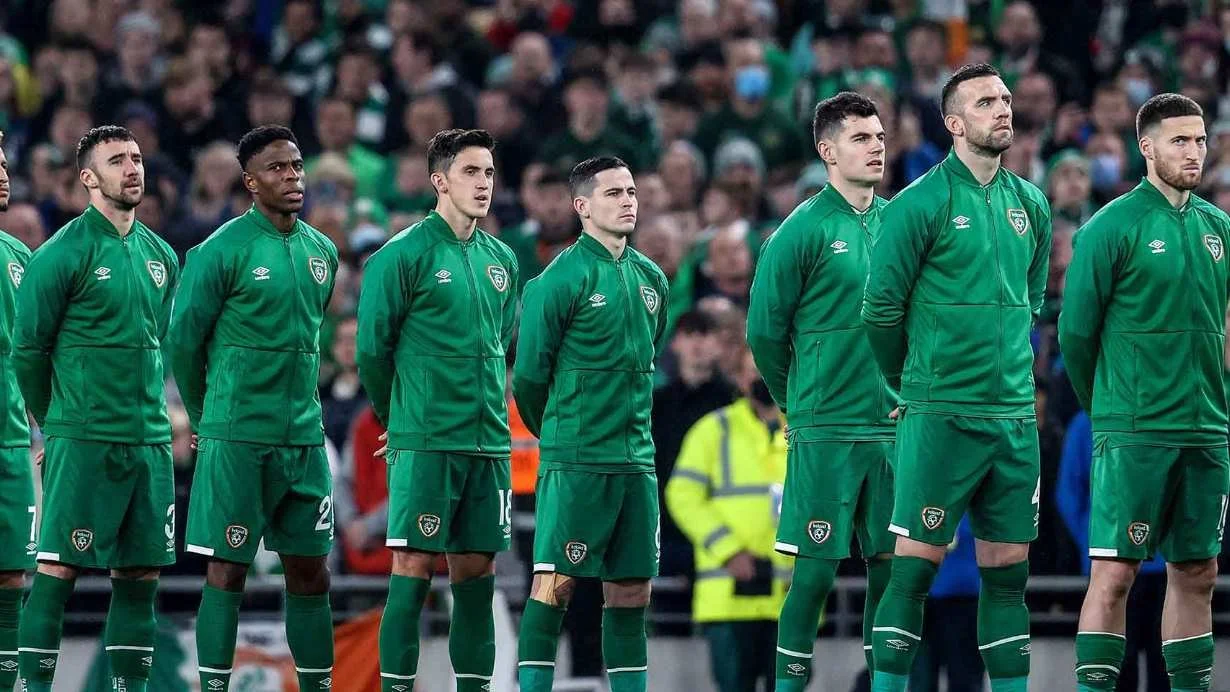
Credit - Aviva
Entering 2026, the scope of the Irish National Team has shifted measurably. After a period of apathy from the public towards a once heralded and beloved team, the National Team has once again become beloved, no more so than the likes of Troy Parrott and Caoimhin Kelleher, who have captured the nation’s imagination once again. But how did we get to this point?
The Men’s National Team entered the year with significant scrutiny about whether they could perform at a high level after five years of consistent underperformance. And with the new unfancied manager, Heimir Hallgrímsson, the team would be under the microscope even further, with the gruelling manager search leaving the public and the media with significant questions.
Hopeless
Starting the year by staying in Nations League B with a victory against Bulgaria in the second leg, the World Cup campaign looked like, for the first time in many years, we could potentially get through. Drawn against Portugal, predicted rightfully so to top the group, but similarly against an ageing Hungary squad who relied upon Dominik Szoboszlai and youth prospect Milos Kerkez. Finally, the weakest in the group was perceived to have been Armenia, which, perhaps, the public had underestimated, as they can be hard to play on their day.
After the first three games, we only managed to scrape a draw against Hungary in the home leg courtesy of a last-minute goal from Adam Idah. The other two games were met with anger as increased pressure from the public mounted against Heimir. However, the criticism of those games was perhaps too harsh, as with the Portugal game, Ireland went away and managed not to concede a goal until a last-minute winner. In the Armenia game, we were poor in our worst performance of the group stage.
After the Portugal and Armenia losses, amid talks of not renewing Heimir’s contract, Ireland had a snatch-and-grab win against Armenia in their second home tie. Considering Ireland was at the bottom of the group, albeit with a mathematical prospect of reaching the playoffs, there was little hope, and Ireland once again looked aimless.
With the hopes of the nation dampened and our talisman, Evan Ferguson, injured, few gave Ireland hope. Ireland must beat Portugal in the Aviva, then overcome Hungary at the Puskas Arena.
Exhilaration
A raucous Irish crowd was in attendance at the Aviva to witness the first of two nights that will undoubtedly feature in Reeling in the Years. Defensively solid, dangerous on the counterattack, and mind games from Heimir got the better of Portugal.
Kelleher had a quieter night than expected as the Corkonian had few chances to worry about besides a long-range effort from Goncalo Ramos in the second half. Then a strong performance from Ogbene, Scales and the soon-to-be hero of the nation, Troy Parrott, would set up the culmination of our qualification efforts against Hungary, who had done their part and gritted out a 1-0 victory against the Armenians away.
Excitement gripped the nation, despite the gruelling tie ahead, for the first time in years, there was hope that the Boys in Green would qualify, not only for a major tournament, but for the World Cup.
Conceding from a corner early on, it seemed to be another glimmer of hope. But Belvedere’s own Troy Parrott persevered, becoming the first Irish player since Robbie Keane to score a hat-trick. With a last-minute winner away from home, Parrott displayed an offensive guile that not possessed by an Irish footballer in years. Ireland was through to the qualifiers to get an opportunity to go to the US, Canada, and Mexico
The Recap
Looking back at the campaign before the playoffs, many wrote off the Irish Team. It can be understandable, considering that they hadn’t displayed an ability to beat teams in high-pressure situations since the O’Neill days.
However, what many failed to consider was the development of the team, alongside the changes that Heimir brought to the table. The Icelandic coach had made Ireland hard to play against again; every performance other than the away result at Armenia showcased grit and defensive solidity.
Kelleher has grown to become one of the best keepers in the league, where his performance in between the sticks looks to push Brentford towards Europe under the Stewardship of Irishman Andrews.
Parrott has been bagging prolifically in the Eredivisie, where his name was linked to the likes of West Ham, Everton, and Spurs as he has not only found his scoring boots, but his confidence.
Despite the performances of Parrott, in another EU country, Ferguson has similarly found his confidence, where, under the watch of Gasperini, he has grown into this Roma team, despite teething and fitness issues.
The youthful team that was managed by St. Patrick’s Athletic manager Stephen Kenny may still be young, but for players of this age have bags of experience.
We may still not qualify with the draw being as favourable as possible, where we face Czechia away from home, then a rehash of a traumatic home tie against an ageing but fancied Denmark at the Aviva.
Regardless of qualification, one fact that cannot be taken from this Irish team; they made the nation hope and dream again. That Kelleher to Scales, who heads it down to Parrott, will be replayed for years, where crucially, it will give the next generation of Irish stars a moment to inspire them to become footballers and foster communities.
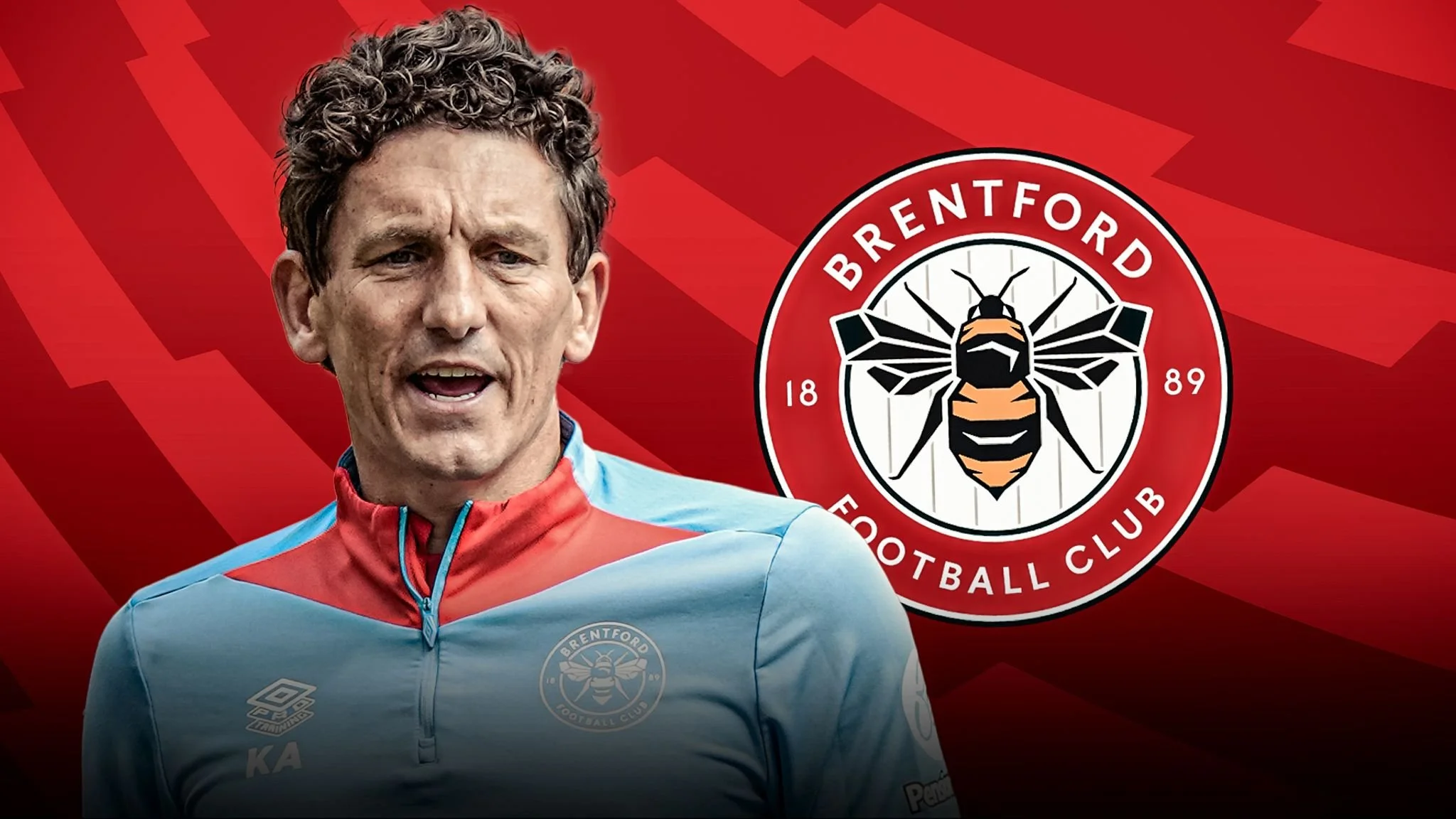
Keith Andrews – Taking Brentford’s Analytical Approach Forward
Jack Whelan - 11th December 2025
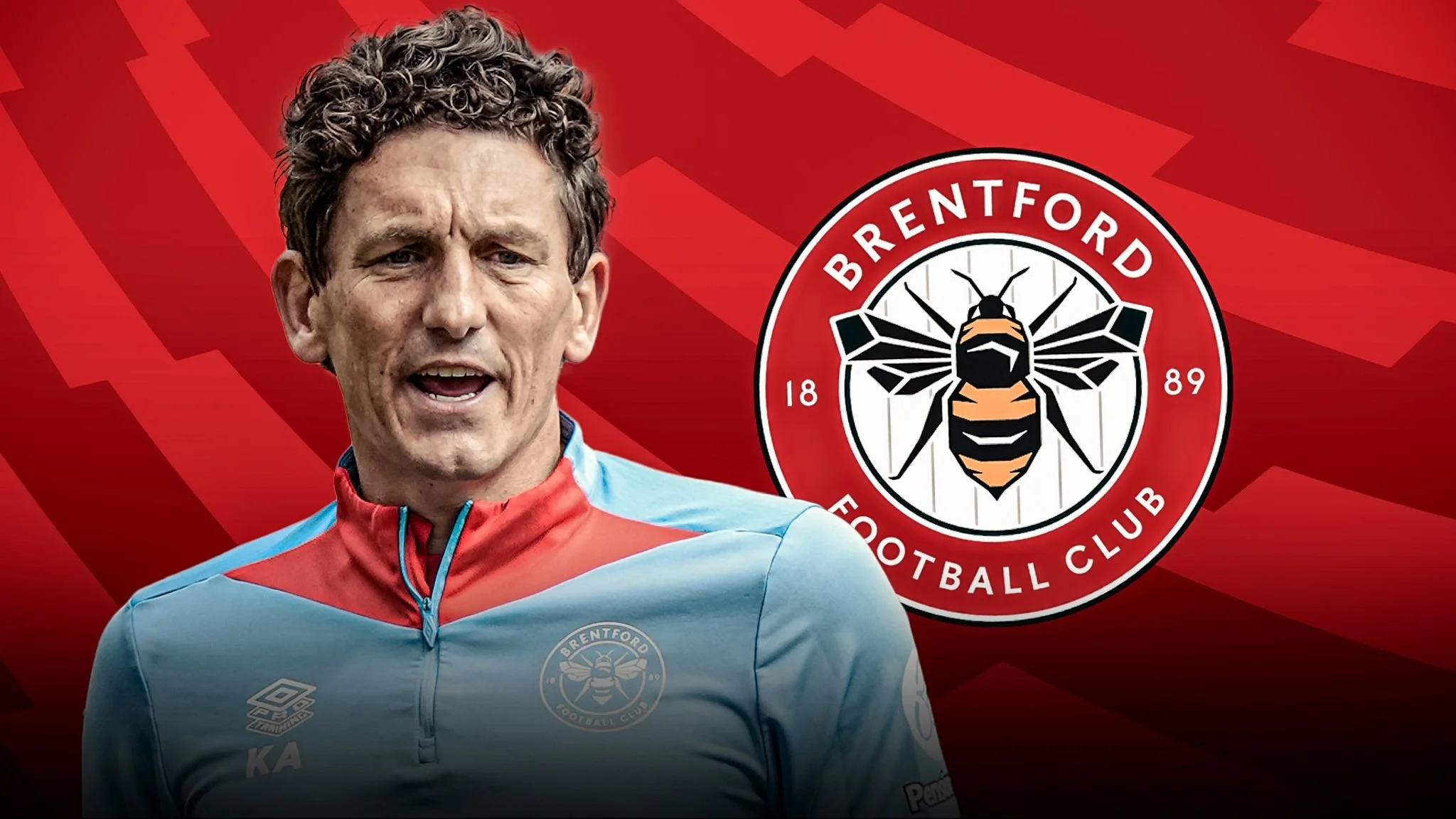
Credit - Sky Sports
Brentford have found themselves using data and a savvy recruitment model which has reaped its rewards, keeping the West London outfit in the Premier League for four seasons prior. Despite this, there was an array of questions posed to Brentford at the start of the season following the loss of key members of staff and players.
After the departure of Thomas Frank to Tottenham, the pressure of appointing the correct manager with the three promoted teams looking stronger than the previous two years was massive. Pair this with the departure of star duo Mbeumo and Wissa, and Brentford were perceived to have a vital summer to prepare for a relegation battle.
The appointment of Dublin-born Keith Andrews was met with a mass of scrutiny. Andrews was seen as lacking experience, having progressed through the Brentford system, going from Set-Piece coach to the vacant head coaching role.
In his first season as a head coach after stints as an Assistant Manager at Sheffield United, MK Dons, and the Republic of Ireland, Andrew was expected to struggle and was considered the favourite to go down after the three newly promoted sides. Andrews has quietly begun to enjoy some success at Brentford, however, picking up wins against Manchester United, Liverpool and West Ham.
Andrews’ experience as a set-piece coach has shone through with the implementation of the highly discussed long-throw. Not only a massive threat due to the lack of offside and chaos that it can cause, but it’s also an incredible means to waste time, too, which can be crucial for a team that likes to sit back after taking a lead, like Brentford has displayed this season.
Despite their proficiency in set pieces, Brentford have only gotten two goals from set pieces this season; their lowest return for set pieces at 14% of their goals have come from such. Showing tactical nous throughout this season and a willingness to change personnel, Andrews’ side has grown in confidence and has emerged as a difficult team to play against.
To examine just the set up for the Manchester United game, Brentford displayed the formation as a 4-3-3 in the lead-up but in the game when set up in their defensive shape as a 5-2-3, with Kayode dropping into the right centre back area and Ouattaro dropping back to mark Dorgu in defensive phases which worked well alongside the front five being compact and forcing Manchester United to go wide. With the defensive solidity and the aforementioned threat of Henderson’s long balls, Brentford would nullify United mostly while capitalising on two counterattack chances, beating the Manchester club 3-1.
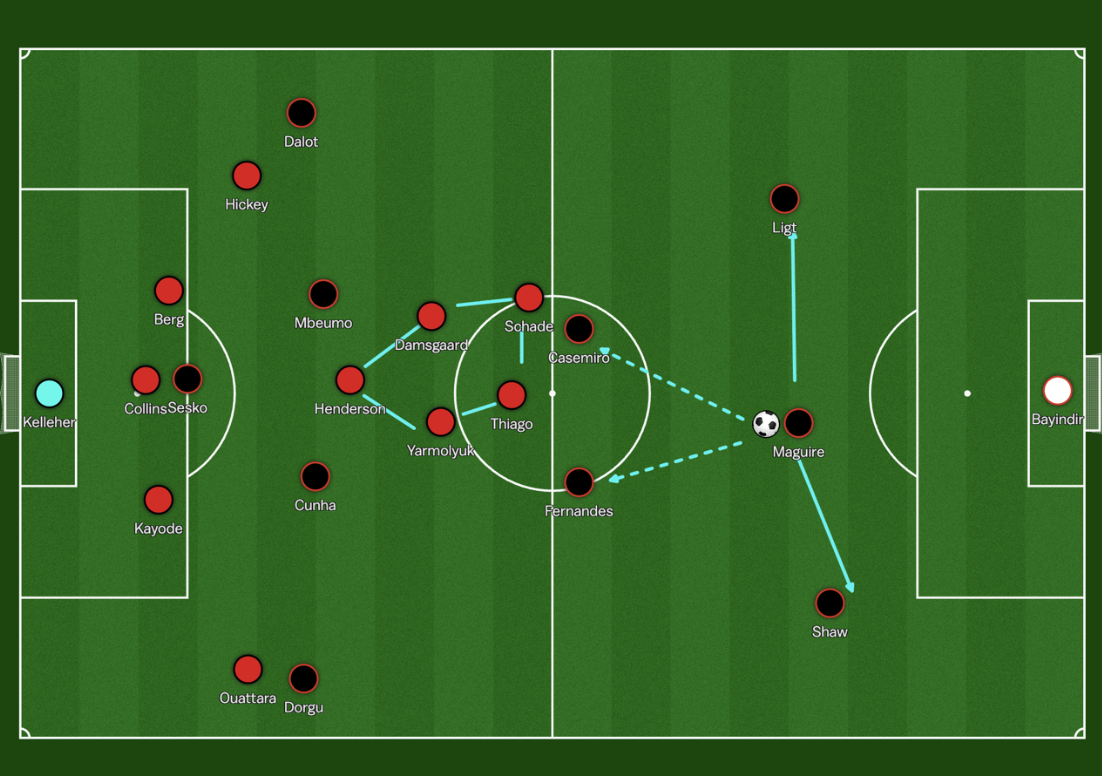
A Snapshot of Brentford’s Defensive shape Against Manchester United
There is no better showcase for this than after Man City’s nervy 1-0 victory over Brentford, Haaland made the comparison of this Brentford team and the Stoke City team that utilised similar tactics and Irish international Rory Delap.
Andrews has implemented a rigid system where counter-attacking phases are seen to be considerably important. Effective use of this has shown itself in the Man United and Liverpool games,where the signing of Jordan Henderson has allowed Brentford to launch diagonal long balls to quickly transition between phases.
Henderson has been one of many players who have benefited from this shift of the system. Igor Thiago, who was signed from Club Brugge last season, did not get the chance to play due to injury. This injury has seemingly had little effect on the Brazilian striker, considering he has had a fruitful campaign thus far, bagging six goals, meaning he is second on the top goal-scorer list,joint with Semenyo.
Of course, it would be ignorant not to evaluate how well run Brentford have been, using their “Moneyball” approach to punch above their weight by using data to decide who would be a suitable purchase. The owner of Brentford, Matthew Benham, had established a sports betting company that allowed him to grow his wealth, subsequently buying the club he was a lifelong fan of.
From the founding of the club, we can see the roots of where Brentford would become the club that they today. Benham uses data to inform bettors which markets would be the most optimal to bet on. From here we can see the mind of Benham and how he has shaped the club, introducing data into recruitment and alongside the development of AI as a tool for performance or recovery.
Using underlying metrics before other clubs, such as xG, to scout for players to replace their outgoings. The club itself has received huge fees for players and has replaced them efficiently,spending a fraction of what they have sold players for. Some key successes of this strategy have been Ivan Toney, who was purchased from Peterborough, who would go on to bag 20 goals in his second Premier League season. Watkins, who was purchased from Exeter before being sold to Aston Villa became a stalwart in their front line and a perennial England national team feature in recent years.
The recruitment in the last summer will prove to be a success for the club too; losing Wissa and Mbeumo so late in the window put a lot of doubt on Brentford. Brentford managed to snap up Kelleher, Kayode and Henderson, who have all made immediate impacts. Overall, the average age of signings for Brentford is 23.5 compared to the outgoings of 25.6. Between this factor and net spend, which lies at -56.6 million, shows the advantages of the data-driven system of Brentford in full swing.
Seeing the data dedicated to Brentford’s sustained success, it’s a wonder that anyone doubted their decision-making process when they decided to promote Andrews to the head coaching role over the summer. However, time will tell if his success is down to how Brentford have established themselves as a smart, forward-thinking club or if Andrews will establish himself as a notable place in football management. From what is seen so far, it looks promising for the former Ireland international.
Artificial Intelligence for Men, Artificial Negligence for Women: Missing Data in the World of Sport
Jack Whelan - 11th December 2025
Credit - FAI
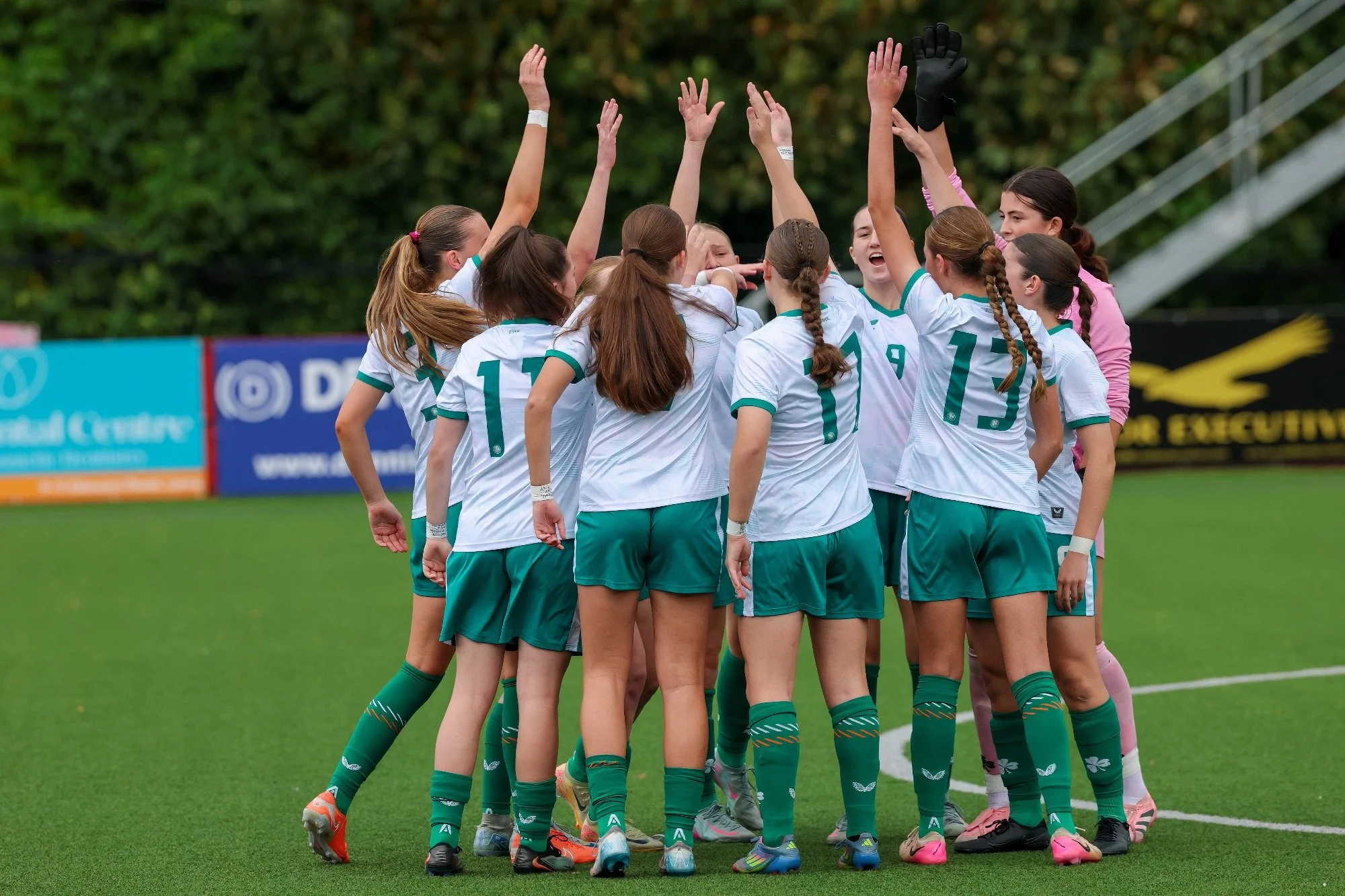
Upon thinking of AI, your mind is brought to the likes of 2001: A Space Odyssey and Her, dystopian futuristic settings but this is our world now. However, the AI that has been a source of debate over the last two years is called Generative AI. Apps such as ChatGPT or DeepAI use these programs to scrape information from the internet and produces a human like content upon being prompted with a request.
Traditional AI is something we use every day. YouTube and Amazon use information from your previous searches and cultivates an algorithm of interests for everyone based on cookies you agree to when upon entering online domains. Traditional AI does not just reach the sectors of retail and entertainment however, as it has the power to revolutionise the world of sport. This has already begun as on YouTube you might have already been exposed to ads of a fitness company named WHOOP which can track sleep, track steps, monitor your stress levels to deliver a picture of what you need to attain to get the most out of your day.
This has been a huge benefit to the fitness fanatics, so it becomes immediately obvious that this would translate to the professional sporting realm. Sporting activities have sprouted into different sectors each with their own individual economies which has seen great advancements in the sporting realm occur over the past few years. Per The Sun, the Premier League champions Manchester City received a whopping £143 million pounds, rugby does not receive as much, with a lower global viewership and less lucrative tv deals.
Maximising an athlete’s performance is paramount to winning, with dedicated sectors of a club’s resources going towards sports science and performance trackers for first team and for academy teams. Upon asking an AI expert from AI Ireland and Alldus, Mark Kelly, he gave me a few insights into the benefit of this technology and why it is being used in the highest echelons of professional sports. Traditional AI has given the opportunity to provide tools that reduces injury risks and optimises training schedules. The introduction of AI into scouting systems has been a huge coup too showing trends in a player’s performance to uncover “Hidden Gems.”
However it is not always smooth as a controversial one for the footballing world is the dreaded VAR (Video Assisted Referees) which has seen a new AI technology, Semi-automated Offsides have recently been rolled out for the Champions League and some of the continental cups such as the World Cup Set to be introduced in the Premier League in the near future after a unanimous vote by the clubs in favour. The system will have AI be a key factor in the technology with tracking software alongside camera footage used to take away the human error in VAR.
Credit - EU Startups
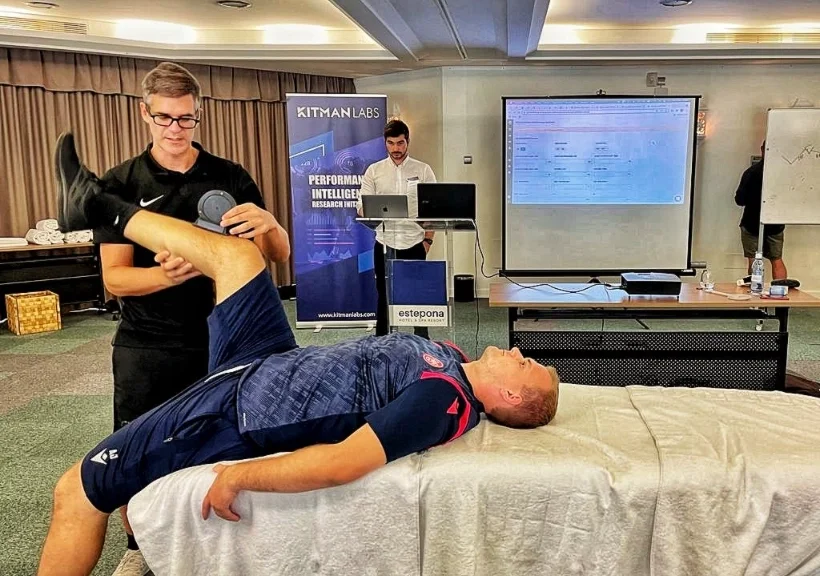
AI technology has obviously been an enormous success in the sporting realm. Kitman Labs, an Irish company has partnerships across the globe from the NFL to rugby. This will continue to expand further in the coming years with the prospects of, as Kelly predicts, “predictive analytics, hyper-personalised training and virtual reality-enhanced coaching”. However, there has been a blind spot that has emerged with sports and AI. Not necessarily the AI technology, but as he put it himself “without the data, the insights are useless”, and due to the lack of data in female sport, AI is not suitable for widespread use.
Why is there a scarcity in data in female sport? There has been an undeniable growth in interest in professional women’s sports with the likes of the WNBA receiving a huge viewership increase after the emergence of Caitlin Clark. Women’s football has also seen a dramatic increase as observed with the 42% average attendance growth at the most recent world cup in 2023. Luckily, Mark gave me some great insights into the challenges that Women’s sports face in the years to come.
The women’s game has a distinct lack of infrastructure, Kelly refers to “grassroots and underage receive less attention, funding and interest”, funding is one of the most dramatic differences between the two. The average wage per year of a female and male player is massive, women receive an average £47,000 pound a year, compared to an excess of £3m pounds (numbers recorded from year 2023). This is applicable to the data gathering for women too, with less money flowing in women’s sports, there is not the funding for trackers to gather the data necessary.
With the lack of funding comes an ugly undertone. Men’s sport receives far more attention on a societal level across all countries while female underage sports in general receive as Kelly lamented “less attention, funding and research interest”. There are less participants in sports for females in underage age-groups, which results in the data having a smaller sample size to base itself from. Men’sfootball has an array of different competitions in stark contrast to the women’s game which has far fewer organised tournaments, pair this with ‘inconsistent record-keeping’ and this has a direct consequence on data leading to fragmented datasets and inconsistent data.
Finally, the last two challenges are the biological variability with growth spurts and hormonal changes that “influence performance metrics, making it harder to create comparable datasets” and the final one is the lack of standardisation, with inconsistent collection methods across different regions and clubs preferring to rely on manual observations, with humans being a variable, this can lead to “bias rather than objective metrics like those provided by AI systems”.
So, what are the consequences of having gaps in data, that arise from the difficulties that face data collection in relation to female athletes? Data has a distinct disadvantage for women, with the clear and evident lack of resources, this has had an overwhelming effect on female athletes already. An article from Sky Sports investigated into the ‘ACL epidemic’ in women’s football where it is estimated that an astonishing 195 elite players suffered an ACL injury in the previous 18 months.
A doctor told Sky Sports that in relation to ACL injuries for women, they are “four-to-six times more at risk” in comparison than men. Thankfully there has been some steps taken to figure out why this is the case. UEFA, in December 2023, finally introduced an ‘expert panel’ to explore the issue and gain more of an overall understanding of it.
Even close to home, Kelly has raised these issues with the GAA and the IRFU. Simply put, without the resources put into data collection, the current data that we have and use, will lead to “misinformed strategies, ineffective training plans and missed opportunities to nurture talent.” The only way we will improve is investment and interest. As for now, with the top-classtechnology that is at our disposal, it is simply unacceptable for us to ignore these huge red flags that are waving in front of our eyes.
The Boys in Green - From Kenny to Heimer
Jack Whelan - 5th January 2025
Credit - BBC
The Irish national team has always been a staple for Irish households. The Irish people love seeing other Irish people flourishing on a national stage. This was seen with the national pride when Cork-native Cillian Murphy, won the Best Actor Academy Award last year, or when the O’Donovan brothers win a medal in the Olympics. For football, mentions of the famous Euro 92’ campaign or when Robbie Brady scored against Italy to send Ireland through to the knockout rounds in Euro 2016 bring back glee and fantastical memories, or when Henry’s infamous handball brings back sorrow.
Irish football fans have had little, to nothing to cheer for in the last four years. Years of financial mismanagement from the FAI have led to a crisis for grassroot football leading to a “lost generation of Irish footballers” the FAI can’t seem to be trusted with any form of money, and overall seem incompetent, and unfit for purpose.
When Martin O’Neill stepped down from the head coaching role for Ireland, Stephen Kenny would be the prodigal son who would take over after two years of Mick McCarthy. A reminiscent name from some of our glory years, although the infamous Saipan campaign perhaps, did not allow McCarthy to fulfil his potential in the early 2000’s. McCarthy would still lead us to some success in his second stint and even led us to a playoff against Slovakia for qualification.
Five Long Years of Poor Form
Originally meant to take place after a play-off to decide if we make it to Euro 2020, the pandemic would soon take precedent worldwide, the match was postponed and Kenny would take charge of the MNT after two years of experience in the U-21’s. In a good position to qualify, with one match to play, on the surface we were in a good position, however, we now had to go from a pragmatic coach, to a progressive one. This transition is not always easy as it sees some teething issues at first. The two managers previous, had utilised low blocks, with long balls towards Shane Long, a striker who possessed the quickness and guile to allow this to work.
Now Kenny desired Irish players to be attractive to teams on the continent and with the crucial lack of funding towards grassroots, this would become evidently challenging, a challenge which has led to a general apathy from casual fans of the NT. He favoured as mentioned before a more progressive style, a 5-3-2 or 5-2-3 in defence but a 3-5-2 or -3-4-3 in attack was favoured throughout the majority of his tenure. We had some better possession statistics with the likes of 66% in our win against Armenia in 22/23. However, Ireland would consistently and frustratingly play to the level of our opponents, a good performance against France would follow with a toothless performance against Greece. These consistent underperformances would begin to show.
June 2020, the Irish team is ranked 34th, as of writing we are at our lowest ranking since 2014, at 60th .The Kenny administration would have lowlights such as losing to Luxembourg at home and not getting an away win against a team who wasn’t a micro-nation such as Gibraltar since 2021, which was the reverse clash with Luxembourg. An Achilles heel in the National Team is the glaring lack of top division quality at the time. Taken from a match in 2022, where we lost 2-1 to Scotland away. We possessed only two starting premier league players in an out-of-form Doherty for Tottenham, and Nathan Collins, who is one of our more promising players, who at the time was playing for Wolves.
Kenny was a manager who, the vast majority, of Irish football fans wanted to succeed, a homegrown manager who attempted a new style of football. Unfortunately, as he began to lose more games, he regressed to the old guard’s long ball style with less possession and fewer ideas as his reign went on, with that not much was left in the fans’ and FAI’s mind when it came to Kenny. His contract was not renewed, and he left the post in November 2023 as a result of a lack of qualification success during his tenure.
Embarrassment
Irish footballing legend John O’Shea would hold the interim management position in February, the original plan was for the new permanent manager to be announced in April. With the vacancy, there comes the speculation, the bookies favourites, and endless media coverage. Ireland had a plan…or so we were told. Names such as Roy Keane and Lee Carsley were discussed ad nauseam, and, as days became weeks, soon became months and eventually Ireland became the laughingstock of the football world.
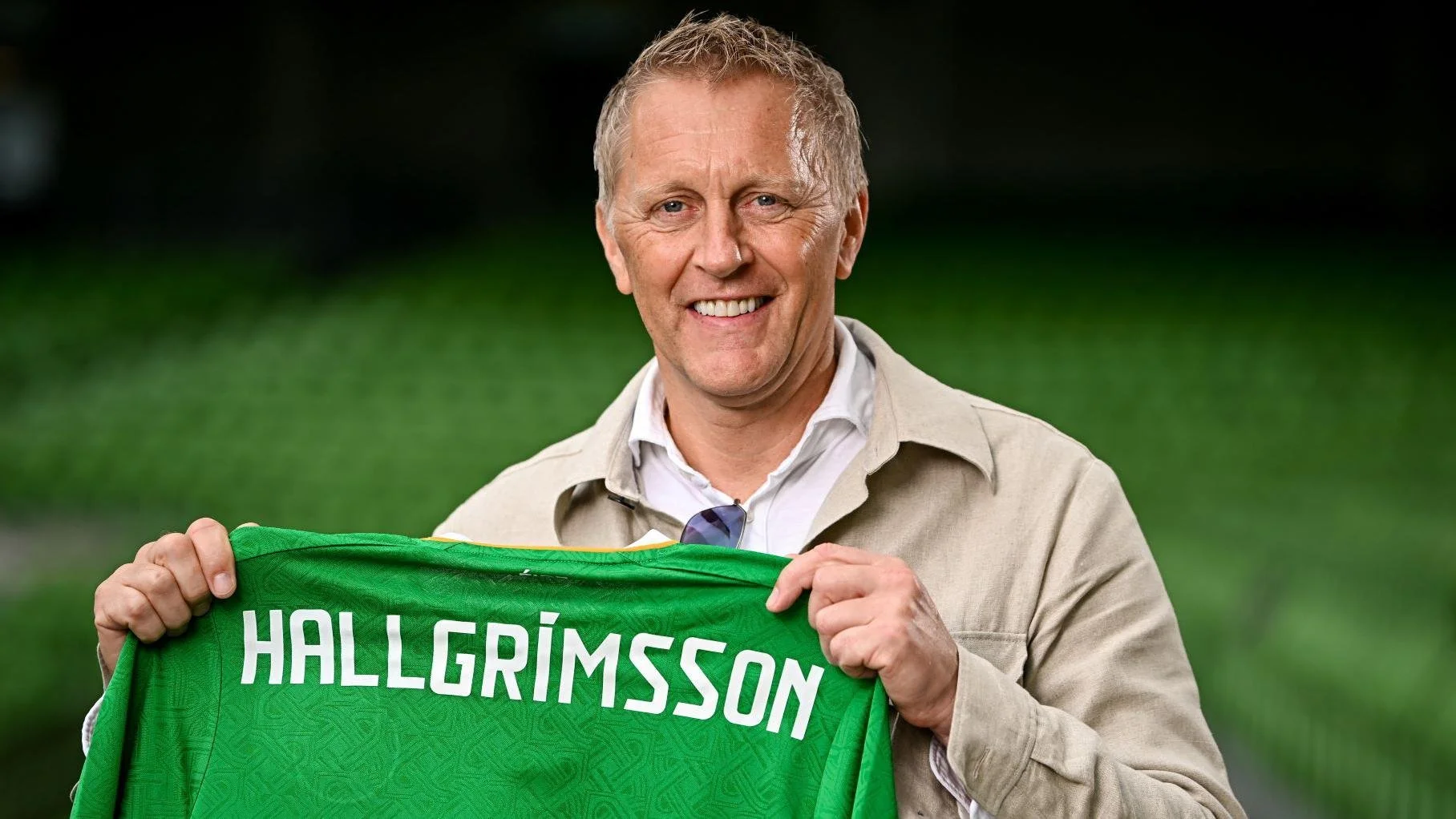
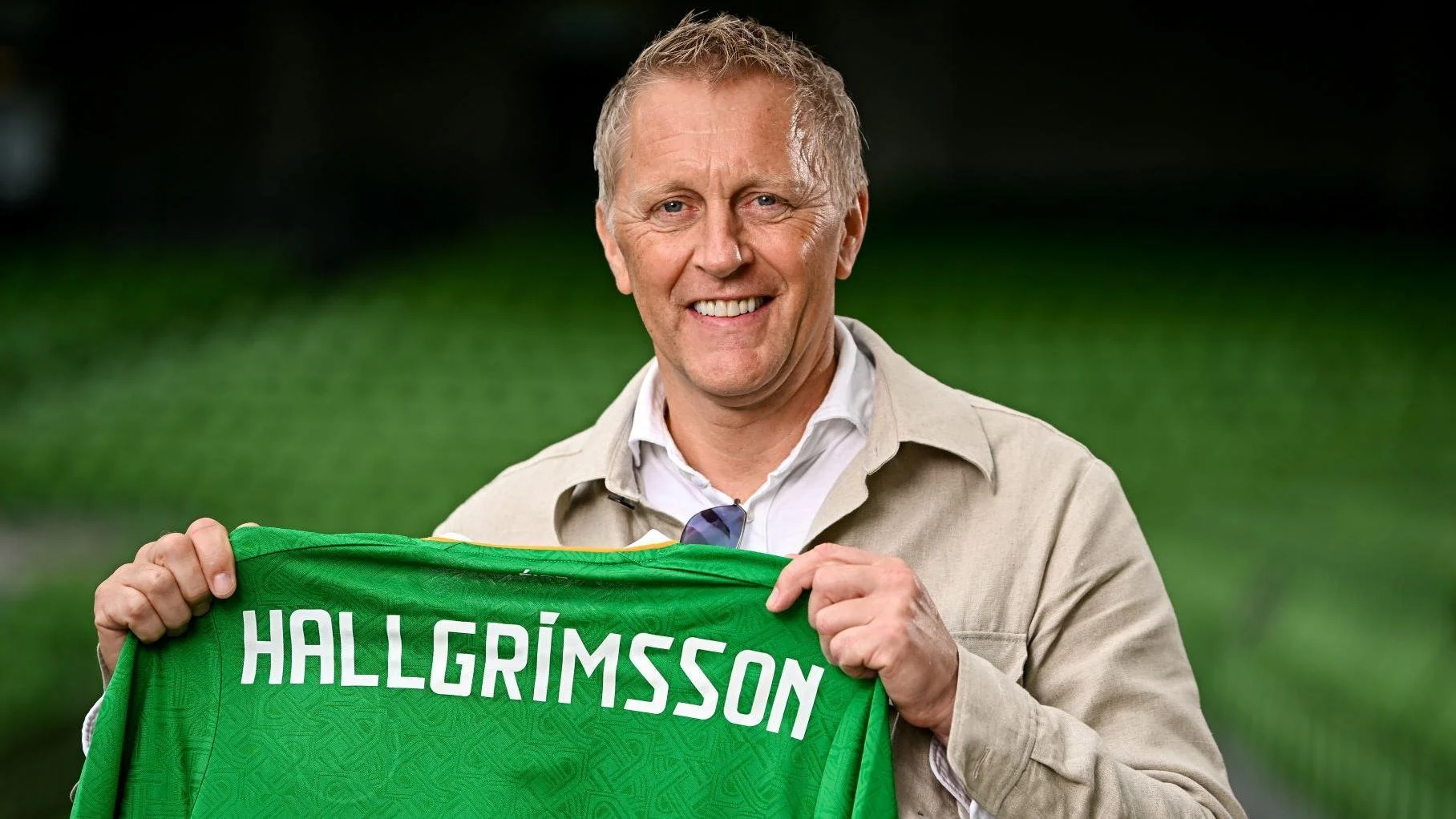
In July, the successor was finally named, in former Iceland and Jamaica coach Heimir Hallgrimsson, as the announcement came, so did the mockery from Irish football fans towards his credentials. The immediate memes and jokes that came with the discovery of Heimer being a dentist, littered the internet and workplaces alike.
The ridicule is not something that should be at the feet of the manager in my opinion, the hiring process of the manager is. The comparison to “teeth-pulling” was immediately made and met with laughter too. Once upon a time, Ireland had names such as Liam Brady, Terry Venables and Kenny Dalglish all in the same management race when Trapattoni won the vacancy in 2008. Richie Sadler called for the head of the whoever was over recruitment
“When the appointment is made, whose resignation is going to come with it”.
The Reality & The Hope
As embarrassing as the job search became, how has Heimir faired so far? Upon seeing his credentials, you may become sceptical. However, there are aspects to see potential in. Firstly, his attitude has been exemplary in how coaches should treat the position. Heimer has talked about his pursuit of “Granny rule” player in his time with Jamaica and wanted to use It to the same effect with Irish diaspora. He has actively been practising Amhran Na bhFhiann, and has shown an optimism unseen in Irish football for many years.
Although a shaky start with two consecutive losses in his first international window. We would have our first piece of joy with our first away win in 3 years. The tie against Finland, had a lot of pressure on it, our supposed “easiest” opponent in our nations league group. We had a poor start with the Irish team going 1-0 down, however with the introduction of Wexford’s Festy Ebosele. The game was flipped on its head, and we won 2-1. As the matches went along, we progressively look more competent too, even our last match an embarrassing 5-0 loss to England, we looked much improved before the red card. Sturdy at the back and dangerous on the counter with the dangerous pace we now possess.
Other issues during the Kenny administration continue to disappear too, with the reluctance to play a lot of promising prospects being a particular grievance I had with Kenny. Ebosele, Szmodics and Kelleher have especially benefitted from the managerial swap, with each looking better as every game goes on.
Besides coaching there is a plethora of different things that lead to my optimism towards the Irish MNT, is the current prospective first team players that we possess. Not only granny rule players such as Dennis Cirkin or Louie Barry, but our own homegrown Irish players who are starting to appear more frequently across the continent. The likes of Jake O’Brien, whose move to Everton has flopped, but regardless had a huge reputation in France after his breakthrough season with Lyon, Kelleher has been one of the most in form keeper in the league this year, in the face of the injury to Alisson, finally on a lull in his career but one of the most exciting Irish prospects in my lifetime Evan Ferguson.
On the continent there has been huge progress too with Troy Parrott instilling a lot more confidence in himself with AZ Alkmaar in the Netherlands, a lesser known prospect but an exciting one for me is Anselmo Garcia McNulty, a tall, physical LB who plays for PEC Zwolle, the young John Joe Patrick has burst on to the scene in Spain as he continues to garner more and more first team minutes this season and finally, close to home Mason Melia the young hotshot 17 year old, striker prospect for St. Pats Athletics has had interest from Bologna and Tottenham. These players should some technical prowess, one that our national team greatly lacks especially when you look at our midfield which is very poor without the likes of Szmodics in it.
All things considered with the rise of the league of Ireland, the disastrous hiring process for Heimir and the brewing, dare I say “Golden Generation” for Irish football. I think I could be naive, but I think we are on the brink of getting something right, we have been steadily improving even in the face of gross mistreatment and incompetence from the FAI. l we can hope is…hopefully at some stage we reach back to 6th in the world like the old Jack Charlton days.
Landmark match at the Aviva sees Bohemians edge narrow victory over Shamrock Rovers
Credit - RTE
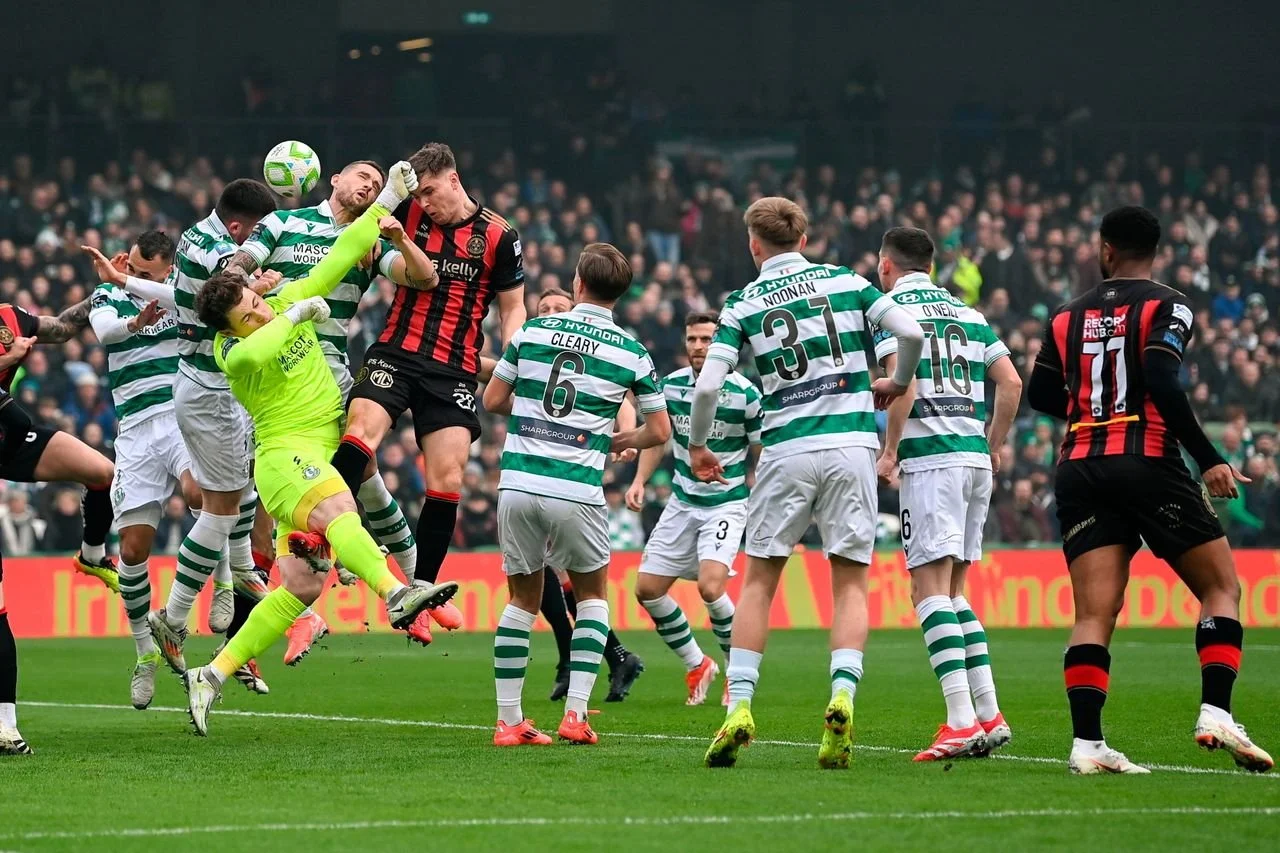
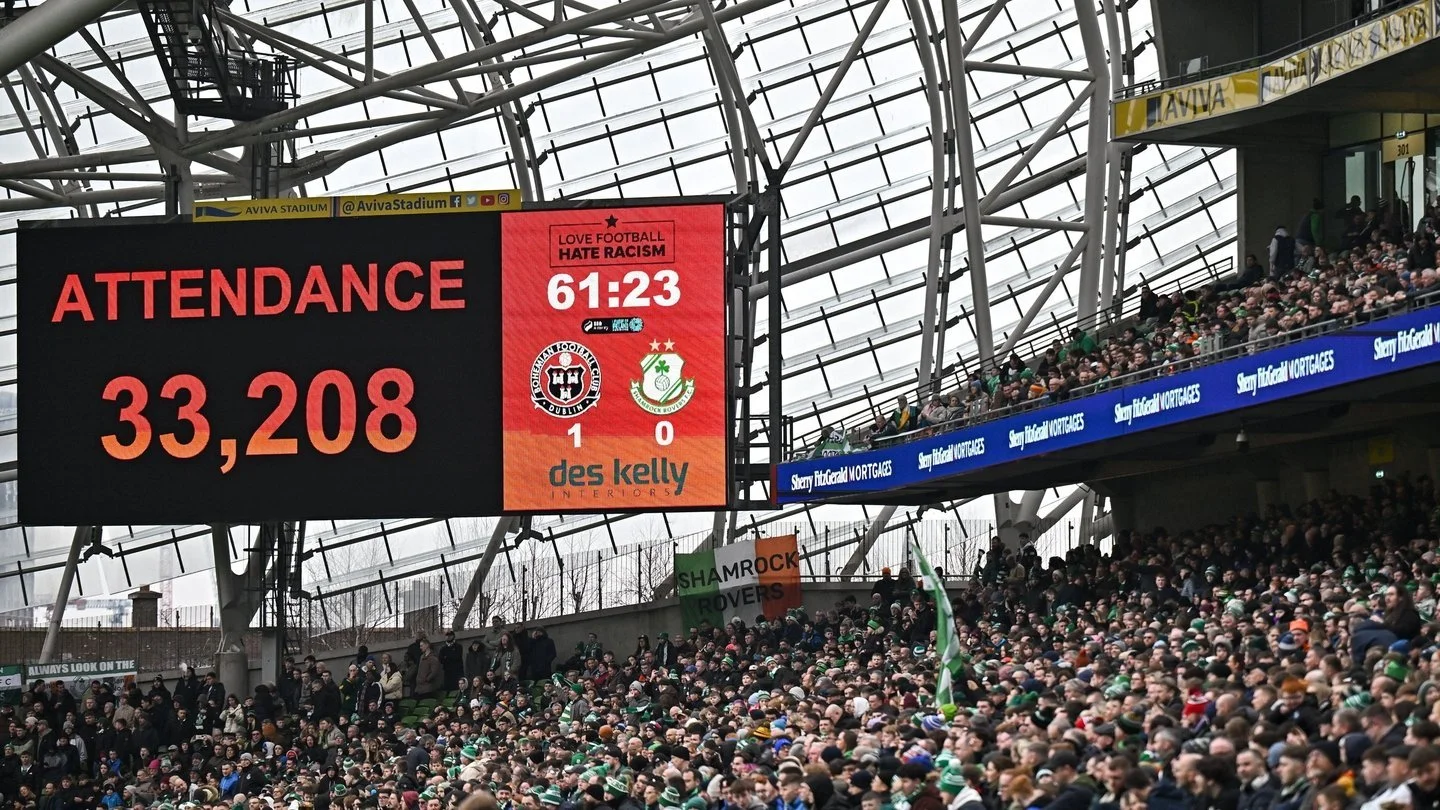
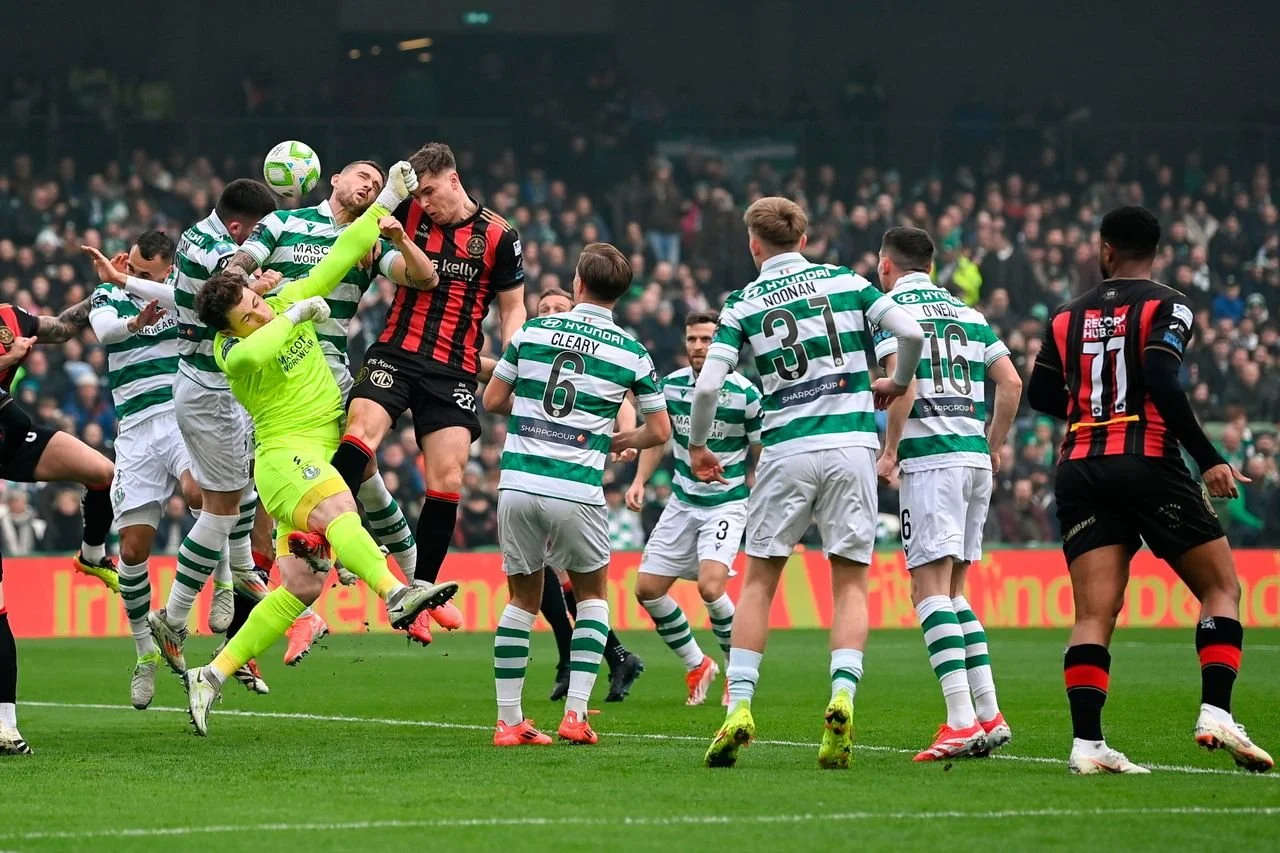
The number of spectators at The Aviva Stadium on Sunday was higher than the average attendance of Ligue Une, Serie A and La Liga, a staggering statistic that was unfathomable even three years ago. The attendance of the ground-breaking match was recorded as a record-breaking 33,208 spectator. This was the first ever League of Ireland domestic match to take place at Irelands national stadium.
The opening match for the League of Ireland campaign saw the Phibsborough outfit move their match, which would have taken place in Dalymount Park, to South Dublin. The match was plastered with the Bohemians logo and red lights to display that this was their home game. Bohemians took up most of the fans with the Rover’s fan allocation in the dip end of the Aviva Stadium.
The game would kick off with a pyro display from both fans, green and red smoke filled the Aviva, in a display becoming synonymous with the league. Lys Mousset, a former Premier League player, garnered his first start for The Gypsies. He seemed without full match fitness, but it was obvious of his quality whenever he was on or off the ball.
Among others for Rovers, Michael Noonan started up front, if the name sounds familiar, he recently broke the record for the youngest goal scorer in a European competition on Thursday against Molde. Between getting back into game shape and the size of the pitch in comparison to Dalymount and Tallaght Stadium, both teams were shaky to start.
Credit - The Irish Independent
Finally, Bohemians broke the deadlock when they went on the counter, when centre midfielder Ross Tierney scored a goal at the 25th minute mark. After both teams threatening to score, the half ended with both teams going in for a team-talk. After the whistle blew for the second half, Bohemians sat back allowing pressure in on themselves. This was seen as Shamrock Rovers began to grow into the game. With growing tension in the Aviva, Rovers had arguably the best chance of the game, but somehow the ball just would not cross the goal line, ultimately this proved to be a blow to the Hoops.
The game ended 1-0, and the landmark match to kick off the League season was over with a buzz for the Gypsies, who managed to win in the first Dublin Derby of the season. This is a watershed moment for the League. With talks of a third division for League of Ireland and the record transfer of Mason Melia, League of Ireland is definitely on the up. With that growth it’s an exciting time for Irish football fans, for those who only watch the Premier League, this season could prove to be one to remember and join the bandwagon.