

Artificial Intelligence for Men, Artificial Negligence for Women: Missing Data in the World of Sport
Jack Whelan - 11th December 2025

Credit - FAI
Upon thinking of AI, your mind is brought to the likes of 2001: A Space Odyssey and Her, dystopian futuristic settings but this is our world now. However, the AI that has been a source of debate over the last two years is called Generative AI. Apps such as ChatGPT or DeepAI use these programs to scrape information from the internet and produces a human like content upon being prompted with a request.
Traditional AI is something we use every day. YouTube and Amazon use information from your previous searches and cultivates an algorithm of interests for everyone based on cookies you agree to when upon entering online domains. Traditional AI does not just reach the sectors of retail and entertainment however, as it has the power to revolutionise the world of sport. This has already begun as on YouTube you might have already been exposed to ads of a fitness company named WHOOP which can track sleep, track steps, monitor your stress levels to deliver a picture of what you need to attain to get the most out of your day.
This has been a huge benefit to the fitness fanatics, so it becomes immediately obvious that this would translate to the professional sporting realm. Sporting activities have sprouted into different sectors each with their own individual economies which has seen great advancements in the sporting realm occur over the past few years. Per The Sun, the Premier League champions Manchester City received a whopping £143 million pounds, rugby does not receive as much, with a lower global viewership and less lucrative tv deals.
Maximising an athlete’s performance is paramount to winning, with dedicated sectors of a club’s resources going towards sports science and performance trackers for first team and for academy teams. Upon asking an AI expert from AI Ireland and Alldus, Mark Kelly, he gave me a few insights into the benefit of this technology and why it is being used in the highest echelons of professional sports. Traditional AI has given the opportunity to provide tools that reduces injury risks and optimises training schedules. The introduction of AI into scouting systems has been a huge coup too showing trends in a player’s performance to uncover “Hidden Gems.”
However it is not always smooth as a controversial one for the footballing world is the dreaded VAR (Video Assisted Referees) which has seen a new AI technology, Semi-automated Offsides have recently been rolled out for the Champions League and some of the continental cups such as the World Cup Set to be introduced in the Premier League in the near future after a unanimous vote by the clubs in favour. The system will have AI be a key factor in the technology with tracking software alongside camera footage used to take away the human error in VAR.
Credit - EU Startups
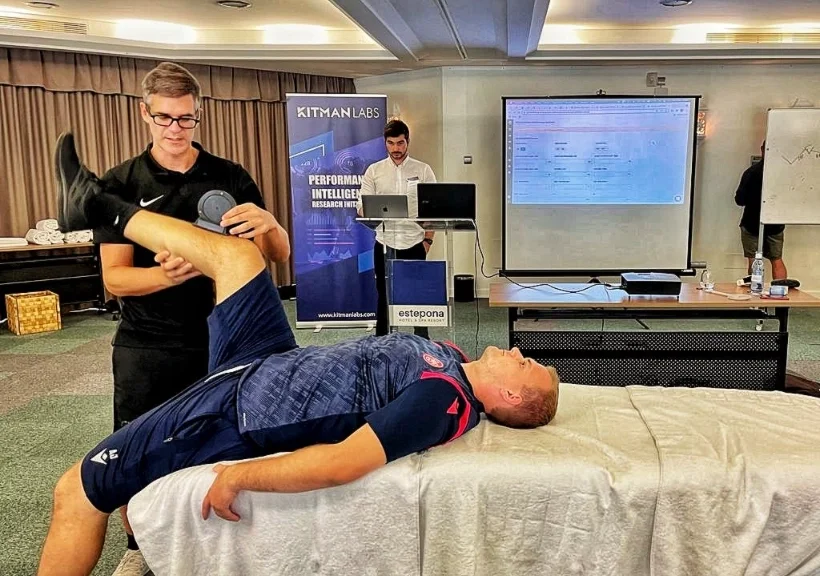
AI technology has obviously been an enormous success in the sporting realm. Kitman Labs, an Irish company has partnerships across the globe from the NFL to rugby. This will continue to expand further in the coming years with the prospects of, as Kelly predicts, “predictive analytics, hyper-personalised training and virtual reality-enhanced coaching”. However, there has been a blind spot that has emerged with sports and AI. Not necessarily the AI technology, but as he put it himself “without the data, the insights are useless”, and due to the lack of data in female sport, AI is not suitable for widespread use.
Why is there a scarcity in data in female sport? There has been an undeniable growth in interest in professional women’s sports with the likes of the WNBA receiving a huge viewership increase after the emergence of Caitlin Clark. Women’s football has also seen a dramatic increase as observed with the 42% average attendance growth at the most recent world cup in 2023. Luckily, Mark gave me some great insights into the challenges that Women’s sports face in the years to come.
The women’s game has a distinct lack of infrastructure, Kelly refers to “grassroots and underage receive less attention, funding and interest”, funding is one of the most dramatic differences between the two. The average wage per year of a female and male player is massive, women receive an average £47,000 pound a year, compared to an excess of £3m pounds (numbers recorded from year 2023). This is applicable to the data gathering for women too, with less money flowing in women’s sports, there is not the funding for trackers to gather the data necessary.
With the lack of funding comes an ugly undertone. Men’s sport receives far more attention on a societal level across all countries while female underage sports in general receive as Kelly lamented “less attention, funding and research interest”. There are less participants in sports for females in underage age-groups, which results in the data having a smaller sample size to base itself from. Men’sfootball has an array of different competitions in stark contrast to the women’s game which has far fewer organised tournaments, pair this with ‘inconsistent record-keeping’ and this has a direct consequence on data leading to fragmented datasets and inconsistent data.
Finally, the last two challenges are the biological variability with growth spurts and hormonal changes that “influence performance metrics, making it harder to create comparable datasets” and the final one is the lack of standardisation, with inconsistent collection methods across different regions and clubs preferring to rely on manual observations, with humans being a variable, this can lead to “bias rather than objective metrics like those provided by AI systems”.
So, what are the consequences of having gaps in data, that arise from the difficulties that face data collection in relation to female athletes? Data has a distinct disadvantage for women, with the clear and evident lack of resources, this has had an overwhelming effect on female athletes already. An article from Sky Sports investigated into the ‘ACL epidemic’ in women’s football where it is estimated that an astonishing 195 elite players suffered an ACL injury in the previous 18 months.
A doctor told Sky Sports that in relation to ACL injuries for women, they are “four-to-six times more at risk” in comparison than men. Thankfully there has been some steps taken to figure out why this is the case. UEFA, in December 2023, finally introduced an ‘expert panel’ to explore the issue and gain more of an overall understanding of it.
Even close to home, Kelly has raised these issues with the GAA and the IRFU. Simply put, without the resources put into data collection, the current data that we have and use, will lead to “misinformed strategies, ineffective training plans and missed opportunities to nurture talent.” The only way we will improve is investment and interest. As for now, with the top-classtechnology that is at our disposal, it is simply unacceptable for us to ignore these huge red flags that are waving in front of our eyes.
